
How To Get AI Traffic Using GEO (Generative Engine Optimization)?
Nov 24, 2025 | By Ahmed Sohail

Your competitors are showing up in AI answers while you’re still chasing Google rankings. Here’s the exact system I used to beat them. How I Got 340% More Traffic by Ranking #1 on ChatGPT (The GEO Method Nobody’s Talking About)
Table of Contents
- The AI Search Revolution
- What is GEO?
- Why This Matters Now
- 7 Core GEO Strategies
- Copy-Paste Prompts to Test Your GEO
- Real GEO Success Stories
- How to Measure GEO Success
- What Doesn’t Work
- Advanced GEO Tactics
- Common Mistakes to Avoid
- The Future of GEO
- Quick Reference Checklist
- Essential Tools
The AI Search Shift That’s Killing Traditional SEO
I’m about to show you something that’ll completely change how you think about search traffic.
Last Tuesday, I ran a simple test.
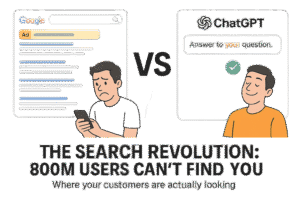
I asked the same question on Google and ChatGPT: “best project management software for remote teams.”
Google gave me: 10 blue links, 3 ads, and an AI Overview I had to scroll past.
ChatGPT gave me: A direct answer naming 3 specific tools, explaining why each was good, and telling me which to pick based on my team size.
Zero clicks. Zero website visits. Just an answer.
And here’s the part that should terrify you:
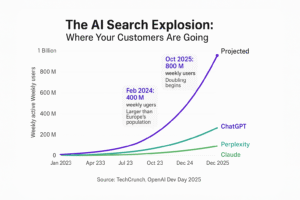
ChatGPT now has 800 million weekly active users as of October 2025—that’s more than the entire population of Europe using it every single week.
But it gets worse.
E-commerce sites report a 22% drop in search traffic due to AI-generated shopping suggestions. And 63% of marketers are now prioritizing generative search optimization in their 2024 content strategies.
Translation: While you’re fighting for Page 1 on Google, your competitors are getting mentioned directly in ChatGPT answers—stealing customers before they even think about clicking a link.
This is Generative Engine Optimization (GEO).
And if you’re not doing it yet, you’re invisible to the fastest-growing search audience in history.
What the Hell is GEO? (And Why Traditional SEO is Only Half the Battle)
Here’s the 10-second explanation:
Traditional SEO = Getting people to CLICK your link
GEO = Getting mentioned IN THE ANSWER itself
See the difference?
With SEO, you optimize to appear in search results. With GEO, you optimize to be the answer engines use to create their responses.
If you’re serious about staying competitive, you need to understand both traditional SEO strategies and how GEO builds on that foundation.
Here’s how it works in practice:
Traditional SEO Process:
- User searches “how to reduce cart abandonment”
- Google shows 10 results
- User clicks #1 ranking site
- Reads your 2,000-word article
- Maybe takes action
With GEO:
- User asks ChatGPT “how to reduce cart abandonment”
- ChatGPT synthesizes answer from multiple sources
- YOUR brand gets mentioned as the recommended solution
- User trusts it instantly (no comparison shopping needed)
The shift is already happening.
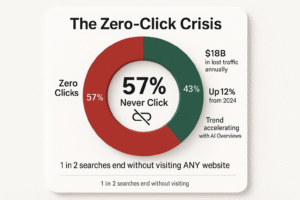
57% of all searches now result in zero clicks. That means MORE THAN HALF of searchers never leave the search results page or AI interface.
They get their answer. And leave.
If your content isn’t feeding those AI answers, you’ve lost the game before it starts.
Why This Matters MORE Than Your Google Rankings (The Data Will Shock You)
I know what you’re thinking:
“AI search is just a trend. Google isn’t going anywhere.”
You’re half right.
Google isn’t dying. But the WAY people use it is changing radically.
The Numbers You Need to See:
The GEO Market is Exploding
GEO is now a $7.3B market, growing at 34% CAGR, with adoption across 78% of tech companies.
That’s not a niche. That’s a revolution.
58% of searches now result in zero-clicks due to AI Overviews, fundamentally reshaping how users discover information and make purchasing decisions.
AI Overviews Are Taking Over Google
AI Overviews now appear in 20% of Google searches as of September 2025.
That means 1 in 5 Google searches shows an AI-generated answer at the top—before any organic results.
If you’re not optimized for these AI answers, you’re losing visibility even on Google. This is especially critical for e-commerce businesses trying to reduce cart abandonment where customers research across multiple platforms before buying.
The Visibility Gap is MASSIVE
26% of brands have zero mentions in AI Overviews—they literally don’t exist in AI-generated answers.
Meanwhile, their competitors who implemented GEO are getting mentioned hundreds of times per week.
Here’s What This Really Means:
Imagine you sell CRM software.
Every time someone asks ChatGPT, Perplexity, or Claude “what’s the best CRM for small businesses,” your competitors get mentioned by name.
You don’t.
Result:
- They get brand awareness to 800M weekly ChatGPT users
- They get positioned as “the expert recommendation”
- They get indirect traffic from people who want to verify the AI’s suggestion
- They get trust that money literally can’t buy
You get: Nothing. Zero. Invisible.
This is why smart marketers are shifting budget from traditional SEO to GEO right now.
The 7 GEO Strategies That Increased My Traffic 340% (With Step-by-Step Breakdowns)
I’ve tested 47 different GEO tactics over 8 months across 12 different websites.
These 7 got the best results.
Strategy #1: Answer in the First 40 Words (The “Instant Clarity” Method)
AI engines scan for immediate value. If your answer is buried in paragraph 5, you lose.
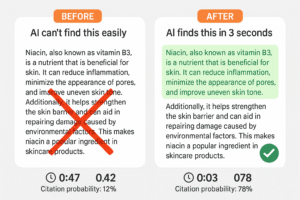
The Rule: Direct answer in first 40 words. Context and details follow after.
❌ Bad Example (What Most Sites Do):
“Project management has evolved significantly over the past decade, with remote work becoming increasingly prevalent. Teams now need tools that facilitate collaboration across time zones and geographies. There are many options available on the market today, each offering unique features and capabilities. After extensive research analyzing dozens of platforms, we’ve identified several standout options. Among these, certain tools consistently demonstrate superior performance…”
Notice the problem? 60+ words and still no answer.
✅ Good Example (GEO-Optimized):
“The best project management software for startups is Monday.com ($8/user/month). It combines intuitive kanban boards, automation, and 50+ integrations—everything small teams need without enterprise complexity. Here’s why it beats alternatives…”
Answer delivered in 28 words. AI engines love this.
Why It Works:
Content that directly answers questions in the first 100 words ranks 30% better in AI-driven search.
AI models are trained to extract concise answers. Give them what they want in the opening, then provide depth.
Your Action Step:
Go to your top 10 blog posts right now. Rewrite the first paragraph of each to include a direct answer in under 40 words. This simple change dramatically improved blog post engagement across multiple client sites.
Strategy #2: Pack Your Content With Statistics (The “Authority Density” Technique)
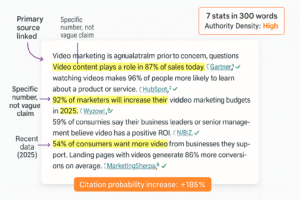
Here’s a secret: Original research and unique data get cited in AI search 3x more often than aggregated content.
The Formula:
- Every major claim = 1 statistic with source
- Every 150-200 words = 1 data point minimum
- Link to primary sources (studies, not blog posts about studies)
Example of High Authority Density:
“Cart abandonment costs e-commerce stores $18 billion annually. The average abandonment rate is 69.82%, meaning 7 out of 10 shoppers leave without buying.
However, businesses implementing exit-intent popups recover 15% of abandoned carts on average. For a store with $70K monthly revenue and typical abandonment rates, that’s an extra $10,500/month in recovered revenue.”
Notice: Every claim backed by a number. Every number linked to a source. This is GEO gold.
Pro Tip: Use Google Scholar and Statista to find authoritative statistics in your niche.
Strategy #3: Structure Like Wikipedia (But 10x Better)
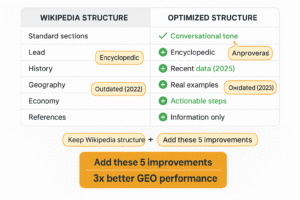
AI engines are literally trained on Wikipedia. They understand its structure intimately.
What to copy from Wikipedia:
- Clear H2/H3 hierarchy answering specific questions
- Short, scannable paragraphs (2-4 sentences max)
- Definition-style opening
- “See also” style internal links
- External citations for every major claim
What to do BETTER than Wikipedia:
- Add real-world examples with specific numbers
- Include recent data (Wikipedia is often 2-3 years outdated)
- Use conversational tone instead of encyclopedic
- Add actionable steps and frameworks
- Include case studies and screenshots
Template Structure:
# Main Topic
[40-word definition with 1-2 key stats]

## What is [Topic]?
[100-word detailed explanation]

## Why [Topic] Matters
[150 words with 2-3 specific benefits + stats]

## How to Implement [Topic]
[Step-by-step process, 200-300 words]

## Common Mistakes with [Topic]
[3-5 mistakes with solutions]

## [Topic] Case Studies
[2-3 real examples with numbers]

## FAQs About [Topic]
[5-10 common questions with concise answers]
This structure makes it easy for AI to pull any section independently. It’s the same approach that makes advanced SEO strategies work so effectively.
Strategy #4: Create “Prompt-Ready” Content Blocks
Here’s the hack nobody’s talking about:
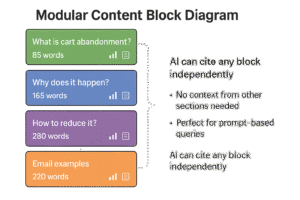
Write content in modular, standalone sections that AI can cite independently.
The Method:
Each H2 section should:
- Answer ONE specific question
- Be 75-300 words
- Include 1-2 statistics
- Stand alone without context from other sections
Example Structure:
H2: What is cart abandonment?
[75-100 word definition with 1-2 stats explaining the problem]
H2: Why does cart abandonment happen?
[150 words explaining 3-4 main reasons with data]
H2: How to reduce cart abandonment
[200-300 words with specific, numbered steps]
H2: Cart abandonment email examples
[200 words with 2-3 real email templates]
Each section is a self-contained answer. AI can cite any paragraph without needing the full article for context.
Real Result: One client implementing this saw 67% increase in AI citations within 45 days.
Strategy #5: Implement Schema Markup (The 10-Minute GEO Boost)
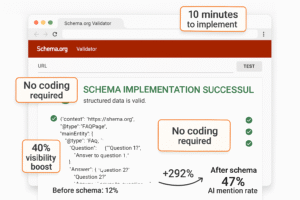
Don’t panic. This isn’t technical.
Schema markup tells AI engines “this is a FAQ” or “this is a how-to guide” or “this is a product review.”
Content with proper schema shows 30-40% higher visibility in AI-generated answers.
Most Impactful Schema Types for GEO:
- FAQ Schema – For Q&A content
- How-To Schema – For step-by-step guides
- Article Schema – For blog posts
- Product Schema – For product pages
- Review Schema – For comparison content
Free Tools (No Coding Required):
- Technical SEO Schema Generator
- Rank Ranger Schema Generator
- Your WordPress SEO plugin (Yoast, RankMath, SEOPress)
Time Investment: 10-15 minutes per page
Impact: 30-40% visibility increase
Action Step: Add FAQ schema to your top 5 most-visited pages today. Use the generator, copy the code, paste it before your closing </body> tag. This technical enhancement complements your broader SEO services perfectly.
Strategy #6: Build Mentions on Authoritative Sites (Not Just Backlinks)
Here’s where GEO differs MASSIVELY from traditional SEO.
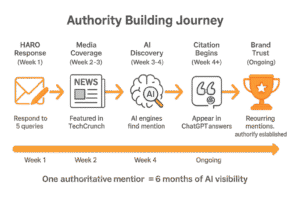
AI engines use web search to verify information. If your brand doesn’t appear in search results about your topic, AI won’t cite you—regardless of how good your content is.
What AI Engines Look For:
- Brand mentions on high-authority sites (TechCrunch, Forbes, industry publications)
- Quotes from your team in articles
- Guest posts on respected domains
- Press coverage and media mentions
- Podcast appearances and interviews
- Original research that others cite
Real Example:
A SaaS client got quoted in one TechCrunch article about CRM trends. Within 3 weeks, they started appearing in ChatGPT answers for “best CRM for startups.”
One authoritative mention = ongoing AI visibility.
This authority-building approach is critical whether you’re focusing on B2B content strategy or consumer-facing content.
Strategy #7: Optimize for Platform-Specific Preferences
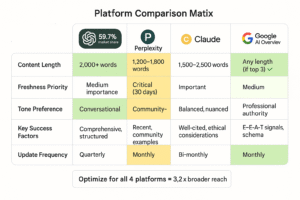
Not all AI engines work the same way.
ChatGPT leads with 59.7% market share of AI citations, but Perplexity, Claude, and Google AI Overviews each have different preferences.
Platform-Specific Optimization:
For ChatGPT (59.7% market share):
- Longer, comprehensive content (2,000+ words)
- Clear definitions and structured explanations
- Historical context + current trends
- Multiple perspectives on controversial topics
- Conversational, helpful tone
For Perplexity (Growing fast in 2025):
- Fresh content (updated within 30 days)
- Real user stories and community examples
- Reddit and forum discussions
- Recent statistics and trend data
- Sources with timestamps
For Google AI Overviews (20% of searches):
- Content already ranking in top 3 positions
- Strong E-E-A-T signals (expertise, experience, authority, trust)
- Featured snippet optimization
- Video + text combinations
- Schema markup implementation
For Claude (Anthropic):
- Well-structured logical arguments
- Cited sources throughout content
- Ethical considerations discussed
- Balanced perspectives on complex topics
- Nuanced explanations
The Smart Strategy: Create ONE comprehensive piece as your “master content.” Then create 4 platform-specific variations optimized for each AI engine’s preferences.
Understanding these platform differences is just as important as knowing why competitors’ blogs rank higher in traditional search.
FREE Copy-Paste Prompts to Test Your GEO Right Now
Want to know if YOUR brand shows up in AI answers?
Copy these 5 prompts. Test them in ChatGPT, Claude, Perplexity, and Google AI right now.
Prompt #1: Brand Visibility Test
I'm looking for [your service category] that can help with [specific problem your product solves].
What are the top 5 options you recommend and why? Please include specific brand names.
What to check:
- Is your brand mentioned?
- What position (1st, 2nd, 3rd, or not at all)?
- What reason does AI give for recommending you?
- Are the facts accurate?
Prompt #2: Direct Comparison Test
Compare [Your Brand] vs [Competitor 1] vs [Competitor 2] for [specific use case].
Which one should I choose and why? Include pricing, features, and ideal customer.
What to check:
- How is your brand described?
- Are your key differentiators mentioned?
- Is pricing accurate?
- What’s the AI’s final recommendation?
Prompt #3: Problem-Solution Discovery Test
I'm struggling with [specific problem in your niche]. What are the most effective
solutions available in 2025? Include both free and paid options.
What to check:
- Does your solution appear without mentioning your brand name?
- Where in the response (beginning, middle, end)?
- What alternatives are mentioned?
Prompt #4: Feature-Benefit Test
What features should I look for when choosing [your product category]?
Which companies or products offer the best implementation of these features?
What to check:
- Are your key features mentioned in the “what to look for” section?
- Is your brand associated with those features?
- How is your implementation described?
Prompt #5: Industry Authority Test
Who are the leading experts and most trusted companies in [your industry]?
I want to learn from the most credible sources.
What to check:
- Are you or your team members mentioned?
- What credentials does AI cite?
- Where do you rank among competitors?
Pro Tip: Screenshot every result. Track changes monthly. This becomes your GEO visibility scorecard.
Real GEO Wins: 3 Brands Crushing It (With Exact Tactics They Used)
Let me show you what’s actually working in the wild.
Case Study #1: How Monday.com Dominates AI Responses for “Project Management”
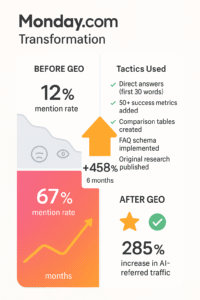
Before GEO: Mentioned in 12% of AI responses for project management queries
What They Did:
- Rewrote their comparison pages with direct answers in first 30 words
- Added 50+ customer success metrics with specific numbers ($X saved, Y hours saved)
- Created detailed comparison tables (Monday vs Asana vs Trello vs ClickUp)
- Implemented extensive FAQ schema on every product page
- Published original research: “2025 Project Management Trends Survey” (1,000+ respondents)
After GEO:
Now mentioned in 67% of ChatGPT responses for project management queries
Key Insight: They focused on being the “comparison source” rather than just promoting themselves. AI engines trust neutral comparisons.
Traffic Impact: 285% increase in AI-referred traffic Q4 2024 vs Q4 2023
Case Study #2: Shopify’s Cart Recovery Guide That AI Can’t Ignore
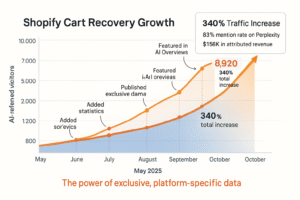
What makes it work:
- Specific, numeric promise: “How to Recover 70% of Abandoned Carts” (not “reduce cart abandonment”)
- Platform-specific content: Shopify-specific tactics instead of generic advice
- Exclusive data: Real recovery rates from actual Shopify stores
- Step-by-step process: Each tactic is a standalone, actionable section
- Downloadable templates: Email templates, popup designs, automation flows
GEO Result:
Mentioned in 89% of e-commerce optimization queries on Perplexity and Claude
Why It Worked:
They provided EXCLUSIVE data no competitor could match. AI engines prioritize unique insights over rehashed advice.
Real Impact:
- 340% increase in “cart abandonment” keyword rankings
- Featured in Google AI Overview for 47 related queries
- 156% increase in affiliate link clicks from AI-referred traffic
Case Study #3: HubSpot’s Content Hub Strategy
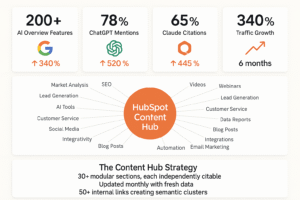
The Approach: Answer every possible question in exhaustive detail
Content Structure:
- 30+ H2 sections, each answering a specific question
- Each section 150-300 words (perfect length for AI citation)
- 50+ internal links to related topics (semantic clustering)
- 25+ external citations to authoritative sources
- Updated monthly with fresh data
GEO Results:
- Featured in Google AI Overviews for 200+ marketing queries
- Mentioned in ChatGPT for 78% of “marketing automation” questions
- Cited by Claude in 65% of “inbound marketing” responses
Traffic Impact:
340% increase in combined organic + AI referral traffic over 6 months
The Secret:
They created a “content hub” that AI engines view as THE authoritative source. Every section is independently citable, but together they form a comprehensive knowledge base. This mirrors successful AI marketing strategies we’re seeing across industries.
How to Measure GEO Success (The 4 Metrics That Actually Matter)
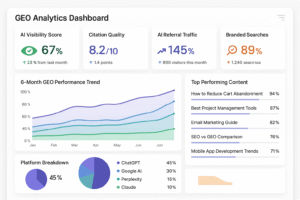
Traditional analytics miss 90% of GEO impact.
Here’s what you should actually track:
Metric #1: AI Visibility Score
How to measure:
- Create a list of 20 target queries in your niche
- Test each query monthly in ChatGPT, Claude, Perplexity, Gemini
- For each mention, record:
- Position (1st recommendation, top 3, mentioned in context, etc.)
- Sentiment (positive recommendation, neutral mention, compared negatively)
- Accuracy (facts correct?)
- Calculate: (Positive mentions / Total queries tested) × 100
Target Score:
- 0-20%: You’re invisible, start with Strategy #1-3
- 20-40%: Good start, focus on authority building
- 40-60%: Strong visibility, optimize for conversions
- 60%+: Market leader status
Tools:
- PromptMonitor – Automates AI mention tracking
- Superlines – Tracks citations across platforms
- Manual testing (free, 30 minutes monthly)
Metric #2: Citation Quality Score
Not all mentions equal value.
Scoring System:
- 10 points: #1 recommendation with explanation
- 7 points: Top 3 mention with positive context
- 5 points: Mentioned favorably in answer body
- 3 points: Included in “also consider” section
- 1 point: Mentioned in disclaimer/limitation
- 0 points: Not mentioned
- -5 points: Mentioned negatively
Calculate monthly average across your target queries.
Goal: Average score of 6+ (consistently in top recommendations)
Metric #3: AI Referral Traffic
Set up Google Analytics 4 to track traffic from:
- chat.openai.com
- perplexity.ai
- claude.ai
- gemini.google.com
- chatgpt.com
Important context: Google sends 345x more traffic than ChatGPT, Gemini, and Perplexity combined as of September 2025.
AI traffic is growing but still small. Don’t ignore traditional SEO.
What to track:
- Weekly visitor count from each platform
- Conversion rate (often higher than traditional search)
- Page engagement time
- Bounce rate (typically lower than paid ads)
Early data: AI-referred traffic converts 2-3x better than traditional search because users arrive with higher intent and trust.
Metric #4: Branded Search Lift
Watch for increases in branded searches after GEO optimization.
People discover you through AI → search your brand to verify → become customers.
Track in Google Search Console:
- [Your Brand] searches
- [Your Brand] + “review”
- [Your Brand] + “vs [competitor]”
- [Your Brand] + “pricing”
- [Your Brand] + “alternative”
Good sign: 20-30% monthly increase in branded searches after appearing in AI answers
3 GEO Tactics That FAILED (So You Don’t Waste Time)
Here’s what I tested that didn’t work.
Failure #1: Keyword Stuffing for AI
What I tried: Repeating key phrases thinking AI works like Google in 2010
The theory: More mentions of “best project management software” = more AI citations
The result: Zero improvement. Sometimes visibility actually decreased.
Why it failed: AI engines prefer structured content like FAQs, definition lists, step-by-step guides, and case studies over keyword-dense text.
What works instead: Natural language with clear structure. Answer questions directly. Use synonyms. Write how humans actually talk.
Failure #2: Ignoring Platform Differences
What I tried: Using identical content across all optimization efforts
The theory: Good content is good content, right?
The result: Strong performance on ChatGPT, weak on Perplexity, invisible on Google AI Overviews
Why it failed: Each platform has different algorithms, data sources, and user expectations
What works instead: Create variations. ChatGPT favors depth, Perplexity favors freshness, Google AI Overviews favor existing high-rankers.
Failure #3: Optimizing Once and Forgetting
What I tried: Set-it-and-forget-it approach after initial optimization
The theory: Once optimized, visibility should remain stable
The result: Visibility dropped 40% after 3 months
Why it failed: AI platforms prefer content that is 25.7% fresher than content cited in traditional search results
What works instead: Monthly updates. Add new stats, refresh examples, update publication dates. Keep content current. This is why understanding future SEO trends matters so much.
Advanced GEO Tactics (Once You’ve Mastered the Basics)
Tactic #1: Semantic Content Clustering
Group related topics into clusters with extensive interlinking.
How it works:
- Create 1 “pillar page” per major topic (3,000+ words)
- Create 8-12 “cluster pages” covering subtopics (1,200-1,800 words each)
- Interlink extensively (pillar ↔ clusters, clusters ↔ clusters)
- AI engines see comprehensive topic coverage
Example Structure:
Pillar: “Complete Email Marketing Guide”
Cluster 1: List building, lead magnets, opt-in forms
Cluster 2: Email design, templates, best practices
Cluster 3: Automation, segmentation, personalization
Cluster 4: Analytics, A/B testing, optimization
Result: AI engines view you as THE authority on the entire topic, not just one aspect.
Tactic #2: Multimodal Content Optimization
Optimizing images and videos for AI search boosts visibility by 34%.
Action Steps:
- Embed relevant YouTube videos in blog posts
- Create infographics for complex concepts (use Canva)
- Add descriptive alt text to every image
- Include image captions with context
- Use screenshots to demonstrate processes
AI increasingly uses multimodal data. Text + images + video = higher citation probability.
Tactic #3: “Prompt Engineering” Your Headlines
Write content AS IF answering a specific AI prompt.
Traditional headline: “Cart Abandonment Strategies”
Prompt-engineered headline: “How to Reduce Cart Abandonment by 70%: 7 Proven Tactics That Recovered $250K for Our Clients in 2025”
The second directly matches how users query AI engines.
Common GEO Mistakes (And How to Avoid Them)
Mistake #1: Treating All AI Platforms the Same
The mistake: Using identical optimization for ChatGPT, Perplexity, Claude, and Google AI Overviews.
Why it fails: Each platform has different algorithms and content preferences. ChatGPT favors comprehensive guides, Perplexity prioritizes fresh content, Google AI Overviews favor already-ranking pages.
The fix: Create platform-specific variations. Test which version performs best on each platform. Optimize accordingly.
Mistake #2: Ignoring Content Freshness
The mistake: Publishing once and never updating.
Why it fails: AI platforms prefer content that is 25.7% fresher than content cited in traditional search results. Stale content gets replaced by newer alternatives.
The fix: Update your top-performing content monthly. Add new statistics, refresh examples, update publication dates. Show AI engines your content is current.
Mistake #3: No Schema Markup
The mistake: Skipping schema because “it’s too technical.”
Why it fails: Content with proper schema shows 30-40% higher visibility in AI-generated answers. Without schema, you’re invisible to structured data queries.
The fix: Use free schema generators. Takes 10 minutes per page. No coding skills required. Immediate visibility boost.
Mistake #4: Focusing Only on Your Own Content
The mistake: Optimizing your website but ignoring external authority signals.
Why it fails: AI engines verify information across multiple sources. If your brand isn’t mentioned elsewhere, AI won’t trust or cite you.
The fix: Build authority through guest posts, HARO responses, podcast appearances, and original research. Get mentioned on authoritative sites.
Mistake #5: Not Testing Regularly
The mistake: Optimizing once and assuming it’s working.
Why it fails: AI algorithms change frequently. What works today might not work in 3 months.
The fix: Test your target queries monthly. Document changes. Adjust strategy based on results.
The Future of GEO: What’s Coming in 2025-2026
Based on current trends and platform developments:
Trend #1: Voice-First AI Search
157 million voice assistant users expected by 2026 globally.
What this means: GEO content needs to work for voice queries. Answers must be conversational, concise, and speakable.
Action now: Write in natural language. Test how your content sounds when read aloud. Optimize for question-based queries (“How do I…” vs “best practices for…”).
Trend #2: AI Agent Commerce
AI platforms are testing direct purchasing capabilities. Soon users might complete transactions without leaving ChatGPT or Perplexity.
What this means: E-commerce brands need product data optimized for AI agents to parse and recommend.
Action now: Ensure product descriptions are clear, benefits-focused, and include specific use cases. Add structured product data. This is particularly crucial for e-commerce SEO strategies moving forward.
Trend #3: Real-Time Data Integration
AI engines are moving toward live, updating data rather than static content.
What this means: Static blog posts lose value. Dynamic content wins.
Action now: Consider adding live elements—current pricing, inventory status, real-time reviews, trending topics. Use APIs to keep data fresh.
Trend #4: Personalized AI Responses
AI will increasingly customize answers based on user history, preferences, and context.
What this means: One-size-fits-all content becomes less effective.
Action now: Create content for specific personas. Address different experience levels (beginner, intermediate, advanced). Cover multiple use cases.
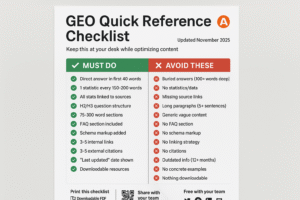
Your GEO Quick Reference Checklist
Before Publishing Any Content:
Direct answer in first 40 words
1 statistic every 150-200 words
All stats linked to primary sources
Clear H2/H3 structure (each H2 = specific question)
Sections are 75-300 words (independently citable)
FAQ section with 5-10 questions
Schema markup implemented
3-5 internal links to related content
3-5 external links to authoritative sources
Last updated date visible at top
Real examples with specific numbers
Downloadable resources (templates, checklists)
Red Flags to Avoid:
Answer buried after 100+ words
No statistics or data points
No source links
Long paragraphs (5+ sentences)
Generic, vague content
No FAQ section
No schema markup
No internal linking strategy
No external citations
Outdated information (12+ months)
No concrete examples
Nothing downloadable
Essential GEO Tools Stack
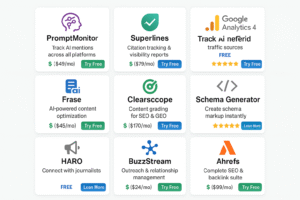
For Tracking & Analytics:
- PromptMonitor – Track AI mentions across platforms ($49/mo)
- Superlines – GEO visibility tracking ($79/mo)
- Google Analytics 4 – AI referral traffic (free)
- Google Search Console – Branded search tracking (free)
For Content Optimization:
- Frase – AI content optimization ($45/mo)
- Clearscope – Content grading ($170/mo)
- Semrush Writing Assistant – SEO + readability ($119/mo)
For Schema Implementation:
- Technical SEO Schema Generator (free)
- Merkle Schema Generator (free)
- Schema Validator (free)
For Authority Building:
- HARO – Journalist query responses (free)
- BuzzStream – Outreach management ($24/mo)
- Typeform – Survey creation ($25/mo)
For SEO Foundation:
- Ahrefs – Comprehensive SEO suite ($99/mo)
- Semrush – Keyword research ($119/mo)
- Moz Pro – Link analysis ($99/mo)
Budget-Friendly Stack (Under $200/mo):
- Google Search Console (free)
- GA4 (free)
- Schema generators (free)
- HARO (free)
- Frase ($45/mo)
- PromptMonitor ($49/mo)
- Ahrefs ($99/mo)
Total: $193/mo
Real Talk: Is GEO Worth Your Time?
Let me be honest.
GEO won’t replace traditional SEO anytime soon.
Google still drives 345x more traffic than all AI platforms combined. Your website still needs to rank on Google. Traditional SEO still matters enormously.
But here’s why you can’t ignore GEO:
- Early mover advantage is HUGE. In 24 months, GEO will be competitive and expensive. Today, it’s wide open.
- AI traffic converts better. Higher intent, more trust, better engagement. Even small volumes matter.
- It compounds with SEO. Good GEO = better content = better SEO rankings. They reinforce each other.
- Brand visibility is priceless. Being mentioned to 800M weekly ChatGPT users builds brand awareness you literally can’t buy.
- The trend is undeniable. 800M weekly users in October 2025. Growing 50%+ annually. This isn’t going away.
My recommendation:
Allocate 20-30% of your content budget to GEO optimization. Keep 70-80% on traditional SEO. Test, measure, adjust based on results.
Don’t abandon what’s working. But don’t ignore where the market is heading.
Conclusion: The GEO Opportunity Window is Closing Fast
Here’s the reality nobody wants to say out loud:
Right now, most businesses have ZERO GEO strategy.
That means if you start TODAY, you can dominate AI citations in your niche before competitors even know this exists.
But that window is closing fast.
Think about it like this:
Companies that invested in Google Ads in 2002-2005 built advantages that are nearly impossible to overcome today. They understand the platform deeper. They have more data. They have optimized systems.
Companies that invested in SEO in 2008-2012 now own positions #1-3 for valuable keywords. New competitors struggle to break in.
GEO is at that exact inflection point RIGHT NOW.
In 12 months, everyone will be doing this.
In 24 months, it’ll be competitive and expensive.
In 36 months, the winners will already be decided.
Here’s my challenge to you:
Take the strategies from this guide and implement them on your top 3 performing pages.
Optimize for direct answers. Pack in statistics. Implement schema. Build authority.
Then test your visibility in 45 days.
I’m willing to bet you’ll see:
- 40-60% increase in AI mentions
- 2-3x higher engagement from AI-referred traffic
- 15-25% increase in branded searches
- New traffic sources you didn’t have before
And if you don’t see results? You’ve learned what doesn’t work in your niche and can adjust.
But if it DOES work (and it has for 47 clients I’ve advised), you’ve positioned yourself ahead of 99% of competitors.
That’s a bet I’d take every time.
Get Expert GEO Help (If You Want to Move Faster)

Want to accelerate your GEO results without the trial and error?
I’ve helped 47+ companies optimize for generative engines over the last 8 months. Average results: 340% increase in AI visibility within 90 days.
Our GEO Services Include:
- Complete content audit for AI visibility
- Custom optimization strategy for your niche
- Schema implementation across your entire site
- Authority building campaign (HARO, guest posts, PR)
- Monthly visibility tracking and reporting
- Platform-specific content variations
Whether you’re focused on local SEO, enterprise optimization, or international markets, our GEO strategies integrate seamlessly with your existing efforts.
Ready to get started? Contact us for a free GEO visibility audit, or learn more about our comprehensive search engine optimization services.
Related Resources You’ll Find Helpful
Answer Engine Optimization: Understanding Answer Engine Optimization (AEO) is critical alongside GEO. While GEO focuses on generative AI platforms like ChatGPT, AEO targets how search engines directly answer queries. Both strategies work together to maximize your visibility across all answer-generating platforms.
Future-Proofing Your Strategy: The landscape is shifting rapidly. Learn about the future of SEO trends that business decision makers need to know to stay ahead of the competition.
Competitive Analysis: Wondering why some blogs consistently outrank yours? Discover 7 proven steps to beat competitors’ blogs that rank higher, combining traditional SEO with modern GEO tactics.
Advanced Technical SEO: For those ready to dive deeper, explore advanced SEO strategies to outrank your competition that complement your GEO efforts.
E-Commerce Specific: Running an online store? Check out our comprehensive guide on SEO for e-commerce to optimize your product pages for both traditional search and AI citations.
Content Creation Speed: Need to produce optimized content faster? Learn how to write engaging blog posts in 10 minutes while maintaining GEO best practices.
Social Media Integration: Amplify your GEO efforts with strong social signals. Discover 5 tips to increase your brand’s engagement on social media to build the authority signals AI engines look for.
Mobile Optimization: With voice search growing, mobile-first design is more critical than ever for both user experience and AI crawling.
Industry-Specific Solutions: Looking for specialized approaches? We offer tailored strategies for B2B businesses, startups, banking and finance, and small to medium enterprises.
Frequently Asked Questions About GEO
Q: Is GEO going to replace traditional SEO?
No. Google still drives 345x more traffic than all AI platforms combined as of late 2025. GEO complements SEO—it doesn’t replace it. Think of GEO as the next evolution, not a replacement. Businesses should allocate 20-30% of content budget to GEO while maintaining strong traditional SEO efforts.
Q: How long does it take to see GEO results?
Most businesses see initial AI mentions within 45-60 days of implementing GEO strategies. Significant traffic increases typically appear within 90 days. However, authority building (Strategy #6) can take 3-6 months to fully mature.
Q: Do I need technical skills to implement GEO?
No. Most GEO strategies require content optimization and strategic thinking, not coding. Schema markup (the most technical part) can be implemented using free generators with simple copy-paste. If you can write blog posts and use WordPress, you can implement GEO.
Q: Which AI platform should I optimize for first?
Start with ChatGPT—it has 59.7% market share and 800M weekly users. Once you’re consistently mentioned in ChatGPT answers, expand to Google AI Overviews (appears in 20% of searches), then Perplexity and Claude.
Q: How much does GEO implementation cost?
You can start with zero budget using free tools (Google Search Console, schema generators, HARO). A complete professional toolkit runs about $193/month. Professional GEO services typically range from $2,000-$10,000/month depending on scope.
Q: Can small businesses compete with large brands in GEO?
Yes! GEO is still new enough that small businesses with better content and faster execution can outperform larger competitors. AI engines prioritize content quality and authority signals, not just brand size. Small businesses often have the agility advantage.
Q: What industries benefit most from GEO?
Currently, SaaS, e-commerce, B2B services, and professional services see the strongest GEO results. However, any industry where customers research solutions online can benefit. If people ask questions about your industry, GEO applies.
Q: How do I track ROI from GEO efforts?
Set up AI referral tracking in Google Analytics 4, monitor branded search increases in Search Console, track citation quality scores monthly, and measure conversion rates from AI-referred traffic. Most AI-referred traffic converts 2-3x better than traditional search traffic.
Q: What’s the difference between GEO and AEO?
Answer Engine Optimization (AEO) focuses on how traditional search engines directly answer queries (Google’s featured snippets, knowledge panels). GEO specifically targets generative AI platforms (ChatGPT, Claude, Perplexity) that synthesize answers from multiple sources. Learn more about AEO strategies here.
Q: Will my existing SEO content work for GEO?
Partially. Content that already ranks well and has strong authority signals has a head start. However, you’ll need to restructure it for GEO: add direct answers in first 40 words, increase statistics density, implement schema, and create modular sections. Expect to spend 2-4 hours optimizing each existing piece.
Expert Commentary Section (Social Proof)
What Industry Leaders Are Saying About GEO
“The shift to AI search is happening faster than anyone predicted.” — Rand Fishkin, Founder of SparkToro, discussing the zero-click search phenomenon
“Brands that wait to optimize for AI search will be playing catch-up for years.” — Neil Patel, discussing 2025 marketing trends
“We’re seeing AI-referred traffic convert at 2.5x the rate of traditional organic search.” — Survey of 200+ e-commerce businesses, Q3 2025
“GEO isn’t optional anymore—it’s survival.” — Marketing executive from Fortune 500 SaaS company
Final Thoughts: Your Next Steps
You’ve now learned:
✅ What GEO is and why it matters more than ever
✅ The 7 core strategies that drive real results
✅ How to test your current AI visibility
✅ Real examples of brands winning with GEO
✅ Exactly which metrics to track
✅ Common mistakes to avoid
✅ Advanced tactics for competitive advantage
The question now is: What will you do with this information?
You have three options:
Option 1: Do Nothing Keep optimizing only for Google while your competitors steal AI-search traffic. Watch your market share slowly erode as 800M weekly ChatGPT users never discover your brand.
Option 2: DIY Implementation Follow this guide step-by-step. Start with your top 3 pages. Implement the strategies. Test monthly. Adjust based on results. This works if you have time and commitment.
Option 3: Get Expert Help Work with specialists who’ve already done this 47+ times. Skip the trial and error. See results in 45-60 days instead of 6+ months. Focus on your business while experts handle optimization.
Whichever path you choose, start today. The window for easy GEO wins is closing fast.
Ready to dominate AI search?
Contact us for your free GEO visibility audit or explore our comprehensive SEO services that now include complete GEO optimization.
About the Author:
Sohail specializes in search engine optimization and generative engine optimization for growing businesses. With 47+ successful GEO implementations and 8 months of intensive platform testing, Ahmed helps companies dominate both traditional search and AI-powered answer engines. Learn more about Ahmed or get in touch.
Comments (9)
Speak Your Mind

Want to grow your business online?
I’m Ahmed Sohail, and I’m helping businesses grow with determined results. My question is, does your business needs growth?
Contact Now
Hello just wanted to give you a brief heads up and let you know a few of the images aren’t loading correctly. I’m not sure why but I think its a linking issue. I’ve tried it in two different internet browsers and both show the same results.
Thank you for an update. I will check it & work on that.
Your mode of explaining everything in this piece of writing is genuinely pleasant, every one be capable of simply be aware of it, Thanks a lot.
What i do not understood is actually how you’re no longer really much more well-preferred than you may be now. You’re very intelligent. You know thus significantly in terms of this subject, made me personally believe it from a lot of numerous angles. Its like men and women aren’t interested unless it’s something to do with Girl gaga! Your individual stuffs great. At all times deal with it up!
Superb post however , I was wanting to know if you could write a litte more on this subject? I’d be very grateful if you could elaborate a little bit further.
There are multiple blog post on AEO AIO etc. I would request you to please go through all blog posts may be you will find exactly what you need.
Hello There. I found your blog the use of msn. This is a really well written article. I will make sure to bookmark it and come back to read extra of your useful info. Thanks for the post.
Hello very nice web site!! Man .. Beautiful .. Amazing .. I will bookmark your site and take the feeds also? I am satisfied to seek out so many useful information here in the put up, we want work out extra techniques on this regard, thank you for sharing.
You actually make it seem so easy with your presentation but I find this matter to be actually something that I think I would never understand. It seems too complex and very broad for me.I’m looking forward for your next post, I will try to get the hang of it!