
The LinkedIn Growth System Most "Experts" Won't Show You (With Data)
Dec 15, 2025 | By Ahmed Sohail
Most people treat LinkedIn like a megaphone.
They post. They disappear.
And they wonder why nothing happens.
Here’s the reality they miss:
Content is only 40% of the equation.
Distribution is the other 60%.
After analyzing 500+ high-growth profiles and running campaigns for 50+ founders, I’ve documented the complete system that bypasses the noise.
Below is the exact framework—with data, hidden layers, and execution rules—that generated over 2,000 inbound leads for my clients last quarter.
Table of Contents
The Distribution Engine (Where Visibility is Won)
Most creators pour 100% of their effort into the content.
Smart creators invest 60% into distribution.
This is how you win the visibility game.
1. Commit to Comment — The #1 Growth Lever
Before you post anything, commit to commenting daily.
Comments are visibility engines. They often outperform posts in reach by 3x because they travel to second-degree networks.
-
Stat: Early comments (within 60 mins) can boost a post’s initial distribution by up to 50% (LinkedIn algorithm data).
-
Execution Rule: Comment on 10–20 relevant posts in your niche before publishing your own. This “warms up” your activity signal.
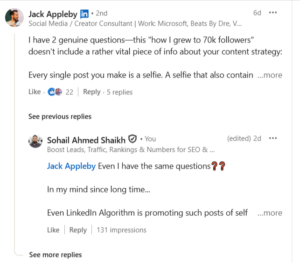
Why it works:
-
Comments travel to second-degree networks
-
Early engagement boosts algorithmic distribution
-
Builds recognition before you even post
2. Self-Comment Threads (The Reach Extender)
Don’t stuff your caption. Use self-comments to extend reach and dwell time.
How to execute:
-
Publish the main post
-
Add your first comment within 2–5 minutes
-
Expand with examples, context, or a soft CTA
Example in practice:
Main Post: “Most people fail on LinkedIn because they post — and disappear.”
First Comment: “Here’s what actually works instead:
Comment strategically (not just ‘great post’)
Reply to replies within 60 mins
Stay visible in conversations for 90 minutes post-publish
This one shift changed my inbound leads.”

Charlie Hills example of Comment Thread
3. Quality > Quantity of Comments
Ten thoughtful comments beat 100 generic “nice post!” comments.
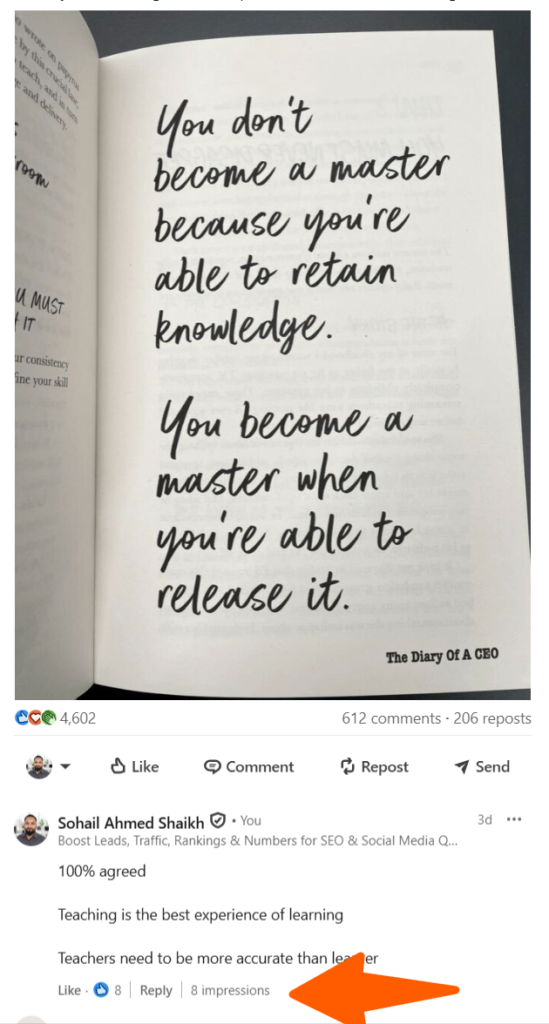
My Engaging Comment on Steven Bartlett LinkedIn post
High-Performing Comment Types:
| Type | Example | Why It Works |
|---|---|---|
| Contrarian (with logic) | “I see your point, but have you considered X data point that challenges that assumption?” | Sparks deeper discussion |
| Attractive Insight | “A missing angle here is [unique insight].” | Provides immediate value |
| Mini-Story | “This reminds me of when I [2–3 line relevant experience].” | Creates human connection |
| Author-Tagging | “Building on your point about [author’s point], this leads to [your extension].” | Shows deep engagement |
Bad Comment: “Great post! 👍”
Good Comment: “The point on consistency hit home. I saw a 40% increase in profile visits when I stopped posting daily and focused on strategic commenting instead.”
4. Smart Link Sharing in Comments
Use sparingly and only when hyper-relevant.
The V-C-L Framework:
-
Value (Add insight first)
-
Context (Explain relevance)
-
Link (Provide resource)
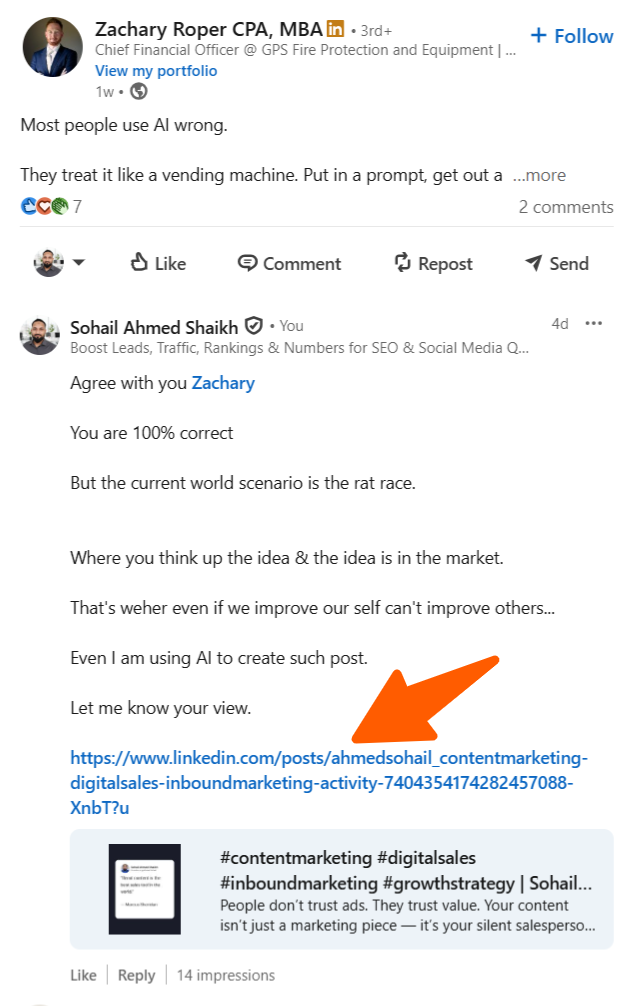
Example: “We tested this exact strategy with 10 founders. The results on lead quality were surprising. Documented the method here (if helpful): [link].”
5. Ask Questions to Spark Replies
Replies boost comment thread visibility.
Algorithm sees active conversation = more distribution.
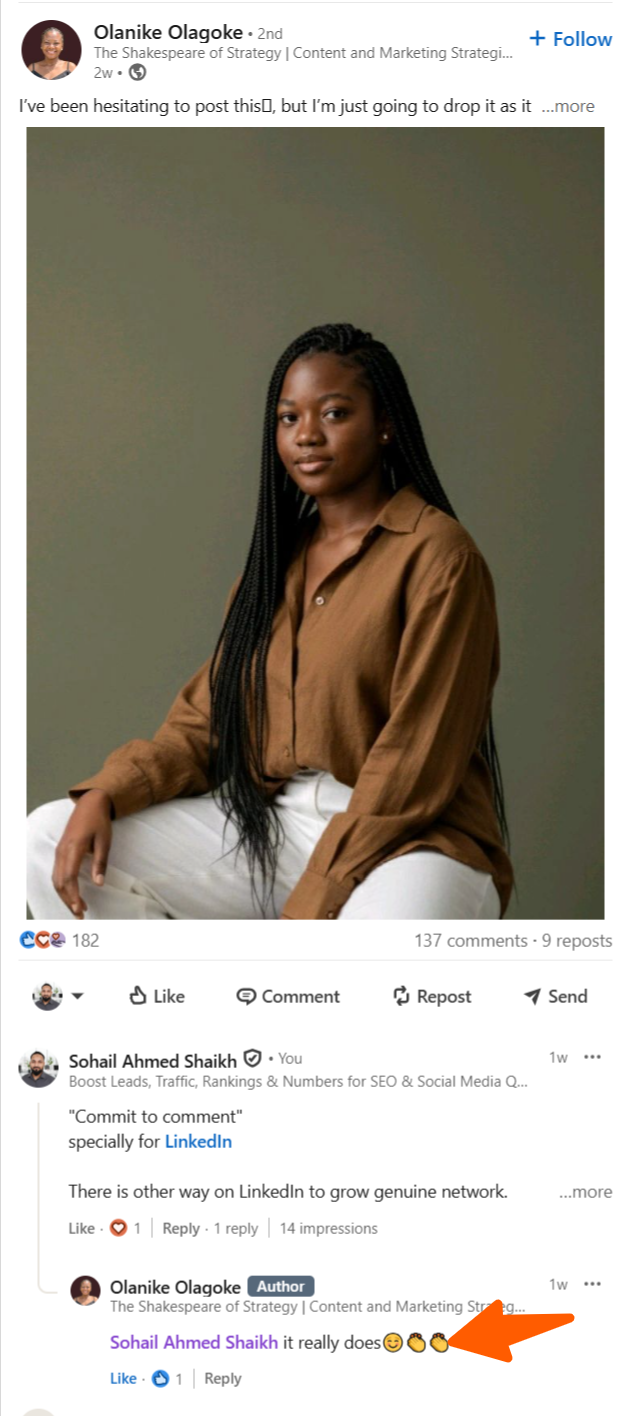
Olanike Olagoke Asked me the question to get her more engagement on LinkedIn
Effective questions:
-
“Curious, what’s the biggest hurdle you’ve faced when trying this?”
-
“Would you prioritize X or Y if resources were limited?”
-
“What’s one assumption here that might be wrong?”
Avoid: Yes/no questions that dead-end the conversation.
Content & Connection (The Attraction Layer)
Distribution gets you seen.
This is what makes people want to engage.
6. Connect with a Relevant Audience
Scenario: You’re a marketing consultant targeting SaaS founders.
5-Day Connection Playbook:
-
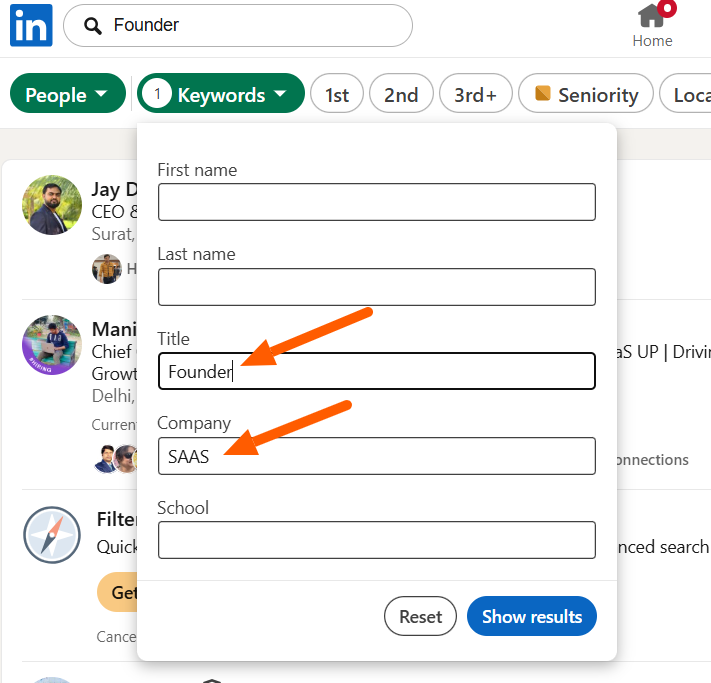
Search:
"Founder" AND "SaaS"on LinkedIn
-
Engage: Leave thoughtful comments on their posts for 5 consecutive days
-
Connect: Send a context-based request
Connection Note Template:
“Loved your post on early-stage hiring. The point on execution gaps is rarely discussed. Would be great to connect.”
Rule: No pitch. No link. Pure value first.
7. Write Captions Like Top Creators
Viral Caption Prompt (Copy/Paste Ready):
“Write a LinkedIn caption on [TOPIC] in the tone and structure of [INFLUENCER]. Make it conversational, insight-driven, and curiosity-led. End with a reflective question. Avoid emoji overload.”
Influencer Bank:
-
Justin Welsh (Clear, direct, actionable)
-
Sahil Bloom (Story-driven, philosophical)
-
Alex Hormozi (Contrarian, bold, data-backed)
-
Lara Acosta (Personal, vulnerable, relational)
-
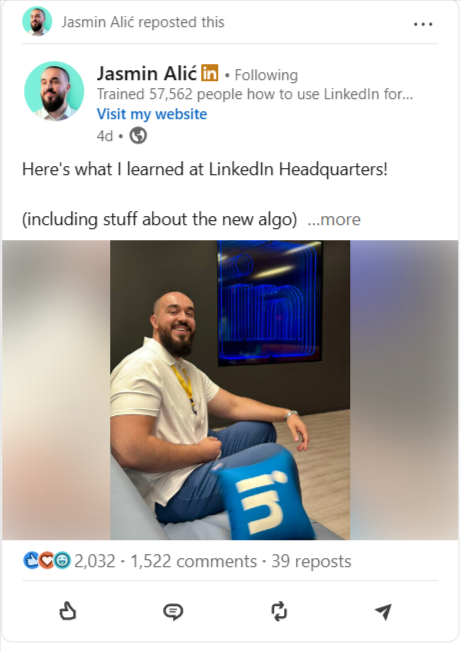
Jasmin Alic (Systematic, framework-driven)
8. Ideal Caption Structure & Length
| Post Type | Character Count | Line Structure |
|---|---|---|
| Short Posts | 300-600 chars | 2-3 lines/para |
| Story Posts | 900-1300 chars | 4-6 lines/para |
| Framework | 700-1000 chars | Bullets/lists |
Critical Rule: The hook must be in the first 140 characters (mobile truncation limit).
Example Structure:
Most people don’t fail at LinkedIn.
They quit before momentum shows.
Consistency compounds quietly.
Are you measuring activity or outcomes?
9. Posting Times & Frequency
Optimal Schedule:
-
Best Days: Tuesday, Wednesday, Thursday
-
Best Times (Local):
-
8:00-10:00 AM (Pre-work scroll)
-
12:00-1:00 PM (Lunch break)
-
5:00-6:00 PM (Commute/wind down)
-
-
Posting Frequency:
-
Minimum: 3x/week
-
Optimal: 4-5x/week
-
Comments: Daily (non-negotiable)
-
Remember: Audience behavior > generic algorithm timing. Test what works for your people.
10. High-Performing Post Types
-
Founder Stories – Relatable, human, builds connection
-
Contrarian Takes – Sparks debate, increases comments
-
Frameworks/Lists – Save-worthy, high utility
-
Lessons Learned – Builds authority through vulnerability
-
Behind-the-Scenes – Creates trust and transparency
11. Viral Post Idea Templates
-
“I stopped doing X on LinkedIn — results doubled.”
-
“Nobody talks about this LinkedIn mistake: [Mistake].”
-
“If I had to restart LinkedIn in 30 days, here’s my day-by-day plan.”
-
“What analyzing 100 comments taught me about growth.”
-
“The invisible rule that changed everything for me.”
12. How to Generate Endless Post Ideas
Capture from these 5 sources:
-
Comments you write
-
Client questions from calls/DMs
-
Mistakes you made this week
-
Blurred screenshots of real scenarios
-
Conversations with peers
Idea Generation Prompt:
“Turn this experience into a LinkedIn post with a strong hook and clear takeaway: [EXPERIENCE]”
The Conversion Layer (DMs & CTAs)
Turning visibility into conversations into opportunities.
13. DM Volume (Safe Range)
| Activity | Daily Range | Key Principle |
|---|---|---|
| New Outreach | 10-20/day | Quality > Quantity |
| Replies & Follow-ups | 20-30/day | Consistency > Volume |
| Total Engagement | 30-50/day | Sustainable Pace |
Warning: Exceeding 100 connection requests/day may trigger restriction.
14. The Engagement DM (No Promotion)
Template:
“Hey [Name], your post on [specific topic] made me rethink [specific point]. How did you arrive at that insight?”
Rules:
-
Reference something specific
-
Show genuine curiosity
-
No links, no pitch, no “let’s connect”
15. The Soft Pitch (After Rapport)
After 3-4 genuine exchanges:
“Based on what you shared about [their challenge], would it make sense to exchange notes on how others are solving this? Happy to share what’s worked for us.”
Advanced move: Offer a specific micro-resource (1-page PDF, curated list) instead of a call.
16. CTAs That Actually Work
Avoid These (Hard CTAs):
-
“Book a call”
-
“DM me”
-
“Click the link below”
Use These (Soft CTAs):
-
“Curious how others see this.”
-
“What’s been your experience?”
-
“Would love your take in the comments.”
-
“Save this for later if you’re not ready now.”
The 5 Hidden Layers (What Most SOPs Miss)
The advanced psychology and algorithm hacks that separate professionals from amateurs.
1. The 60-Minute Rule
The Silent Algorithm Truth:
Early engagement velocity > total engagement.
Action Plan:
-
0-15 mins: Reply to every comment instantly
-
15-60 mins: Ask follow-up questions to commenters
-
60-90 mins: Engage with commenters’ profiles
Result: Signals “high-value conversation” to the algorithm, triggering secondary distribution waves.
2. Feed Training
You’re not just consuming content.
You’re teaching LinkedIn what you are.
Every action trains the algorithm:
-
Comment on low-quality posts → See more low-quality
-
Linger on strategic content → See more strategic
-
Ignore salesy content → See less salesy
Rule: Engage only where your future clients already hang out.
Your feed becomes your brand environment.
3. The “One-Person Rule”
Most posts fail because they’re written for “everyone.”
High-performing posts are written for one person.
Before posting, ask:
-
Can I name the specific person I’m writing to?
-
What specific objection am I addressing?
-
What moment of doubt are they having?
If you can’t answer these, the post isn’t ready.
4. Conversation Capture
Smart operators don’t just reply.
They document.
Weekly Capture List:
-
Best comments you wrote
-
Replies that sparked debate
-
DMs that turned warm
-
Recurring questions from audience
Repurpose Into:
-
Future posts (50% of your content)
-
Case studies
-
Product improvements
-
Sales enablement
Content is recycled conversation.
5. The Authority Lag
LinkedIn has a built-in reputation delay.
Typical Timeline:
| Weeks | Phase | What’s Happening |
|---|---|---|
| 1-3 | Silence | Platform learning your behavior |
| 4-6 | Familiarity | Name recognition building |
| 7-10 | Recognition | “I see you everywhere” comments |
| 10-14 | Inbound | “Can you help me?” DMs |
Most quit at week 3.
Trust is still loading.
Compound interest hasn’t matured.
The Meta Truth
LinkedIn isn’t a content platform.
It’s a reputation memory machine.
People may not like every post.
But they remember:
-
How you think
-
How you respond to criticism
-
How you show up consistently
-
What you stand for
That’s what compounds.
That’s what builds authority.
That’s what drives opportunity.
Key Takeaways
-
Distribution > Content. Commit to commenting before posting.
-
Protect your momentum. Engage heavily for 90 minutes after posting.
-
Write for one person, not a crowd. Specificity beats generality.
-
Document conversations. They’re your best content source.
-
Trust the lag. Consistency compounds between weeks 7-14.
-
Train your feed. Your engagement dictates your visibility.
-
Soft everything. CTAs, pitches, DMs—value first, always.
Author Bio
Sohail Ahmed Shaikh is a Digital Marketing Consultant and Founder of AhmedSohail.com. He helps founders, agencies, and global brands turn visibility into conversions through SEO, LinkedIn growth systems, and data-driven marketing strategies.
Final Note: LinkedIn rewards people who participate, not just publish. Build conversations — growth follows.

Want to grow your business online?
I’m Ahmed Sohail, and I’m helping businesses grow with determined results. My question is, does your business needs growth?
Contact Now