
How to Optimize for E-E-A-T (Experience, Expertise, Authority, Trust)
Jan 26, 2026 | By Ahmed Sohail
If you want to rank in 2025, you need more than just keywords.
You need Trust.
According to a recent study by Amra & Elma, 81% of consumers say they need to trust a brand before they even consider buying from it.
But here is the problem:
Google’s algorithm has evolved. It’s no longer just about matching keywords. It’s about matching intent with credibility.
And with the rise of AI content, Google has tightened the screws.
If your site lacks E-E-A-T (Experience, Expertise, Authoritativeness, and Trustworthiness), you are invisible.
The good news?
Optimizing for E-E-A-T is actually straightforward… if you have the right framework.
In this guide, I’m going to show you exactly how to build a “Trust Fortress” around your website.
We will cover:
-
What E-E-A-T actually is (and what it isn’t).
-
The “Trust Barometer” strategy I use for clients.
-
Step-by-step implementation for YMYL pages.
-
Industry-specific strategies (SaaS, Health, E-commerce).
Let’s dive right in.
Table of Contents
Chapter 1: What is E-E-A-T? (The “Secret Sauce” Explained)
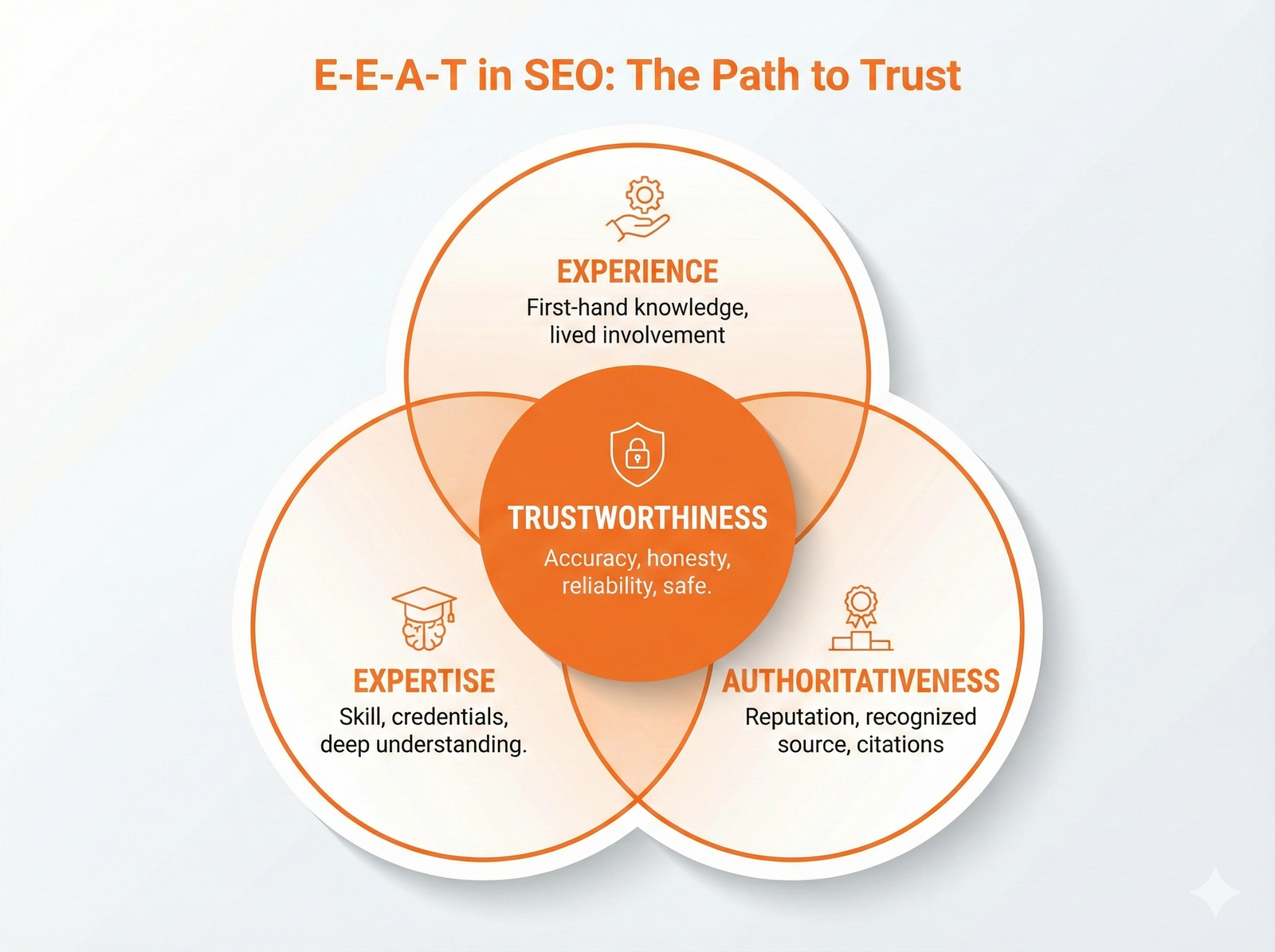
E-E-A-T stands for Experience, Expertise, Authoritativeness, and Trustworthiness.
It comes directly from Google’s Search Quality Rater Guidelines. These are the guidelines human raters use to teach the algorithm what “good” looks like.
Here is the breakdown:
-
Experience (The New “E”): Does the content creator have first-hand experience? Did they actually use the product, visit the place, or solve the problem?
-
Expertise: Does the creator have the necessary knowledge or skill?
-
Authoritativeness: Is the website (or author) a go-to source for the topic?
-
Trustworthiness (The Most Important): Is the page accurate, safe, and honest?
Why the extra “E”?
Google added “Experience” because AI can generate expertise (facts). But AI cannot experience things. It hasn’t hiked the trail or tested the software.
To understand how this fits into the bigger picture of search evolution, check out my guide on The Future of SEO Trends Business Decision Makers Need to Know.
Chapter 2: Why You Absolutely Need E-E-A-T Now
You might be wondering:
“Is E-E-A-T a direct ranking factor?”
Technically? No.
Google has confirmed (via Semrush) that there is no single “E-E-A-T score.”
However…
E-E-A-T signals to Google’s systems (like the Helpful Content System) that your content deserves to rank.
Here is why you need it:
-
To Beat AI Content: AI scrapes facts. It cannot replicate the nuance of human experience.
-
To Survive Core Updates: Almost every recent Core Update has targeted sites with low trust signals.
-
Conversion: High E-E-A-T doesn’t just help rankings; it helps sales. The Edelman Trust Barometer 2024 shows that 63% of people trust businesses more than they trust the government. You need to leverage that.
If you are looking to crush your competition, you need to layer E-E-A-T on top of Advanced SEO Strategies to Outrank Your Competition in 2024.
Chapter 3: Where to Use E-E-A-T (The YMYL Rule)
Do you need high E-E-A-T for a funny cat video website?
Probably not.
But you need it for YMYL topics.
YMYL = Your Money or Your Life.
These are pages that could impact a person’s future happiness, health, financial stability, or safety.
Critical Areas for E-E-A-T:
-
News: International affairs, business, politics.
-
Finance: Investments, taxes, retirement planning.
-
Shopping: E-commerce pages where people spend money.
-
Health: Medical advice, drugs, hospitals.
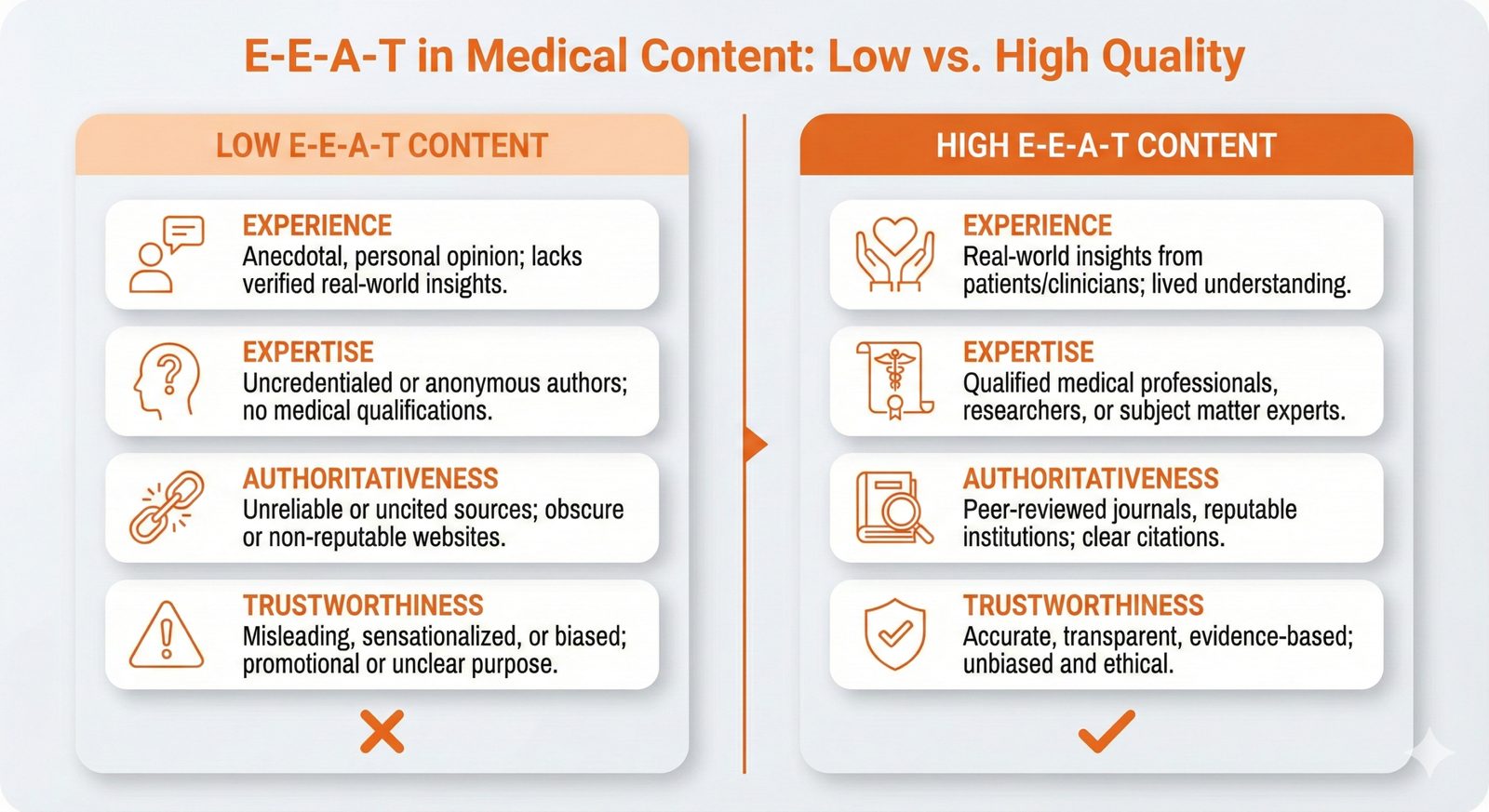
If your site touches on any of these, E-E-A-T is mandatory.
For example, if you are running an online store, simply having a product page isn’t enough. You need to prove you are a legitimate business. Read more on this in my guide on SEO for E-commerce: A Comprehensive Guide.
Chapter 4: Step-by-Step Implementation Strategy
So, how do you actually “do” E-E-A-T?
It’s not a plugin you install. It’s a mindset shift.
Here is my 4-step framework:
Step 1: Audit Your Authors
Every piece of content needs an owner.
-
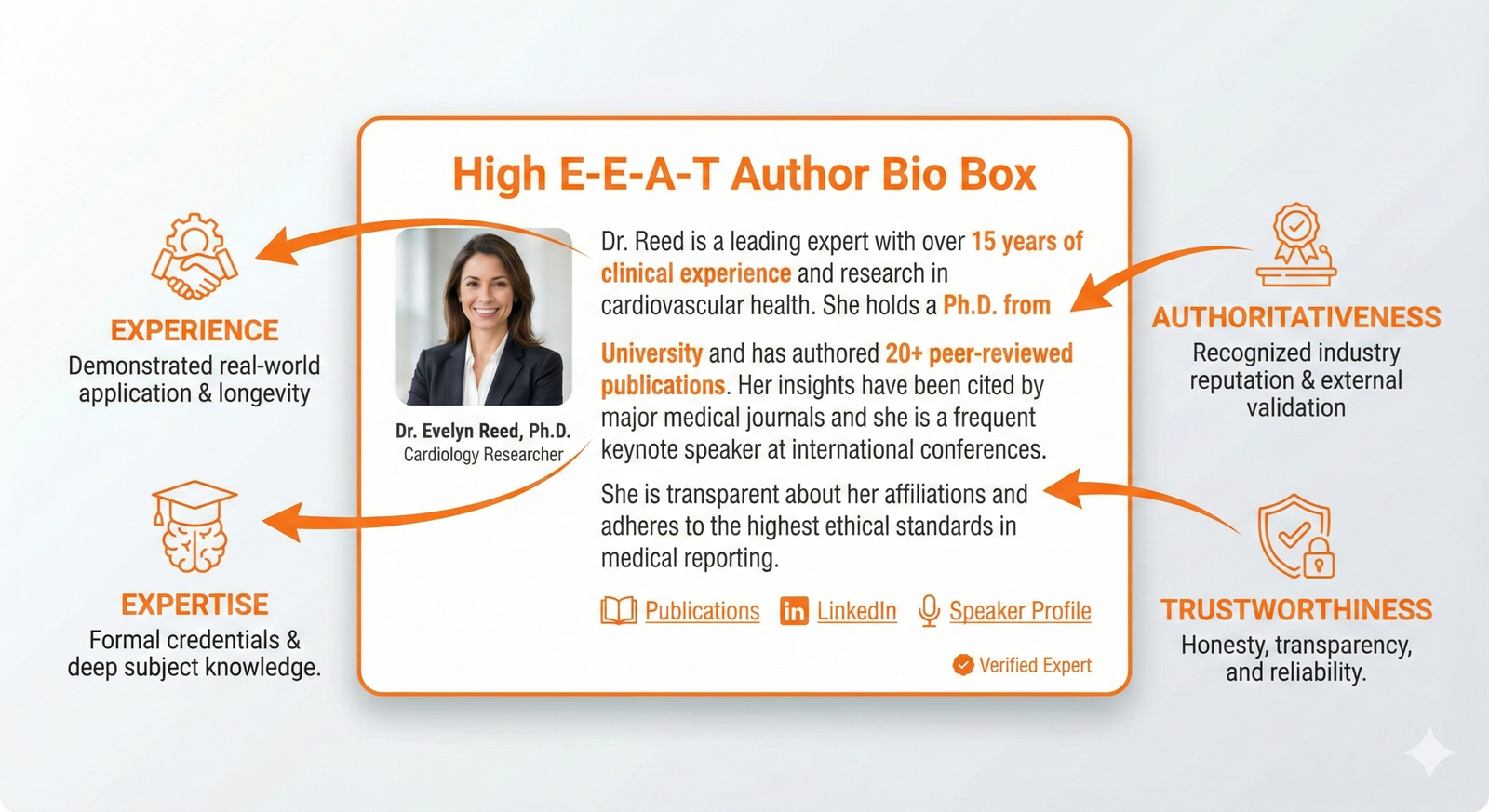
The Fix: Create robust author bios. Link to their LinkedIn, Twitter, and other articles they’ve written.
-
Pro Tip: If you use freelance writers, ask them to verify their identity.
Step 2: Inject First-Hand Experience
Stop rewriting the top 3 search results.
-
The Fix: Use phrases like “When I tested this…” or “In our case study…”.
-
Resource: Learn how to weave this into your writing with How to Write Engaging Blog Posts in 10 Mins.
Step 3: Transparent Editorial Standards
Tell users how you create content.
-
The Fix: Create an “Editorial Policy” page. Explain how you fact-check and why you are unbiased.
Step 4: Off-Page Signals (The Hard Part)
You need other experts to vouch for you.
-
The Fix: Get mentions from other authoritative sites in your niche. It’s not just about backlinks; it’s about brand mentions.
For a deep dive into building a strategy that incorporates these elements, check out the B2B Content Strategy Framework for Success.
Chapter 5: Specific Parameters & Live Examples
Let’s get granular. Here are the specific parameters Google Quality Raters look for.
1. The “About Us” Page
Parameter: Who is responsible for the website?
-
Bad Example: A generic page saying “We are a team of passionate experts.”
-
Good Example: A page listing the CEO, the address, the history of the company, and photos of the office.
-
Why it works: It proves you are a real entity.
2. Evidence of Content Review
Parameter: Accuracy verification.
-
Strategy: Add a “Medically Reviewed By” or “Fact Checked By” byline.
-
Live Example: Look at Healthline. Every article has a reviewer.
3. Contact Information
Parameter: Accessibility.
-
Strategy: Don’t hide behind a contact form. List a physical address, a phone number, and an email.
-
Connection: This is crucial for local businesses. See how this ties into broader success in SEO and The Bottom Line: Real Life Success Stories.
Chapter 6: Industry-Specific Detailed Strategies
E-E-A-T isn’t one-size-fits-all. Here is how to tailor it to your industry.
E-Commerce
The Goal: Trust in transaction.
Strategy:
-
-
Detailed Return Policy (easy to find).
-
Real customer photos in reviews (Experience).
-
Secure checkout badges (Trust).
-
Resource: Recover lost sales by building trust using How to Recover 70% of Abandoned Carts on Shopify.
-
Health & Medical
The Goal: Patient safety.
-
Strategy:
-
Content must be written or reviewed by medical professionals.
-
Cite peer-reviewed journals (using
.eduor.govsources). -
Update content every 6-12 months.
-
SaaS & Tech
The Goal: Technical competence.
-
Strategy:
-
Case studies with real data.
-
Whitepapers explaining the methodology.
-
Comparison posts that are actually fair (not just bashing competitors).
-
Context: If you are discussing tech talent, show you know the market. Read Unlocking India’s Tech Talent: A Guide to Hiring Remote Developers.
-
Mobile & App Development
The Goal: Usability and Security.
-
Strategy:
-
Demonstrate that you understand the shift to mobile-first indexing.
-
Showcase security certifications for app development.
-
Resource: Understand the stakes in Why Mobile First Design Matters to Boost Engagement.
-
Chapter 7: Hard FAQs (The Stuff No One Tells You)
Q: Can I fake E-E-A-T with AI authors?
A: No. Google has patents that can map author footprints across the web. If your “Expert Dr. Smith” doesn’t exist anywhere else online, you will get flagged.
Q: Does bad design hurt E-E-A-T?
A: Yes. A broken layout or intrusive ads signal low trustworthiness. It looks “spammy.”
Q: How does this impact Answer Engine Optimization (AEO)?
A: AEO is all about being the single best answer. High Authority is the primary filter for being selected by AI overviews.
-
Learn More: Answer Engine Optimization 2025.
Q: Why do my competitors rank without E-E-A-T?
A: They might have massive off-page authority (backlinks) that overrides on-page E-E-A-T gaps. But they are vulnerable. You can beat them.
-
Analysis: Why Your Competitors’ Blogs Rank Higher.
Conclusion
E-E-A-T isn’t a checklist. It’s a reputation.
It is the difference between a website that looks like a content farm and a website that looks like a brand.
Start by auditing your “About” page today. Then, look at your top 10 pages and ask: “Does this demonstrate first-hand experience?”
Ready to build a strategy that dominates the SERPs?
I help businesses turn content into revenue. Contact me today to audit your current SEO strategy.
About the Author
Ahmed Sohail is a Digital Marketing Strategist and SEO expert who helps B2B and E-commerce brands scale. With a focus on data-driven SEO and high-converting content strategies, he breaks down complex algorithms into actionable growth plans.
Download This Checklist as PDF – >> EEAT SEO Lead Magnet
Comments (2)
Speak Your Mind

Want to grow your business online?
I’m Ahmed Sohail, and I’m helping businesses grow with determined results. My question is, does your business needs growth?
Contact Now
Your blog is a breath of fresh air in the crowded online space. I appreciate the unique perspective you bring to every topic you cover. Keep up the fantastic work!
Ive read several just right stuff here Certainly price bookmarking for revisiting I wonder how a lot effort you place to create this kind of great informative website