
25 SEO Tactics That Improved Organic Traffic Last Year
Jan 19, 2026 | By Ahmed Sohail
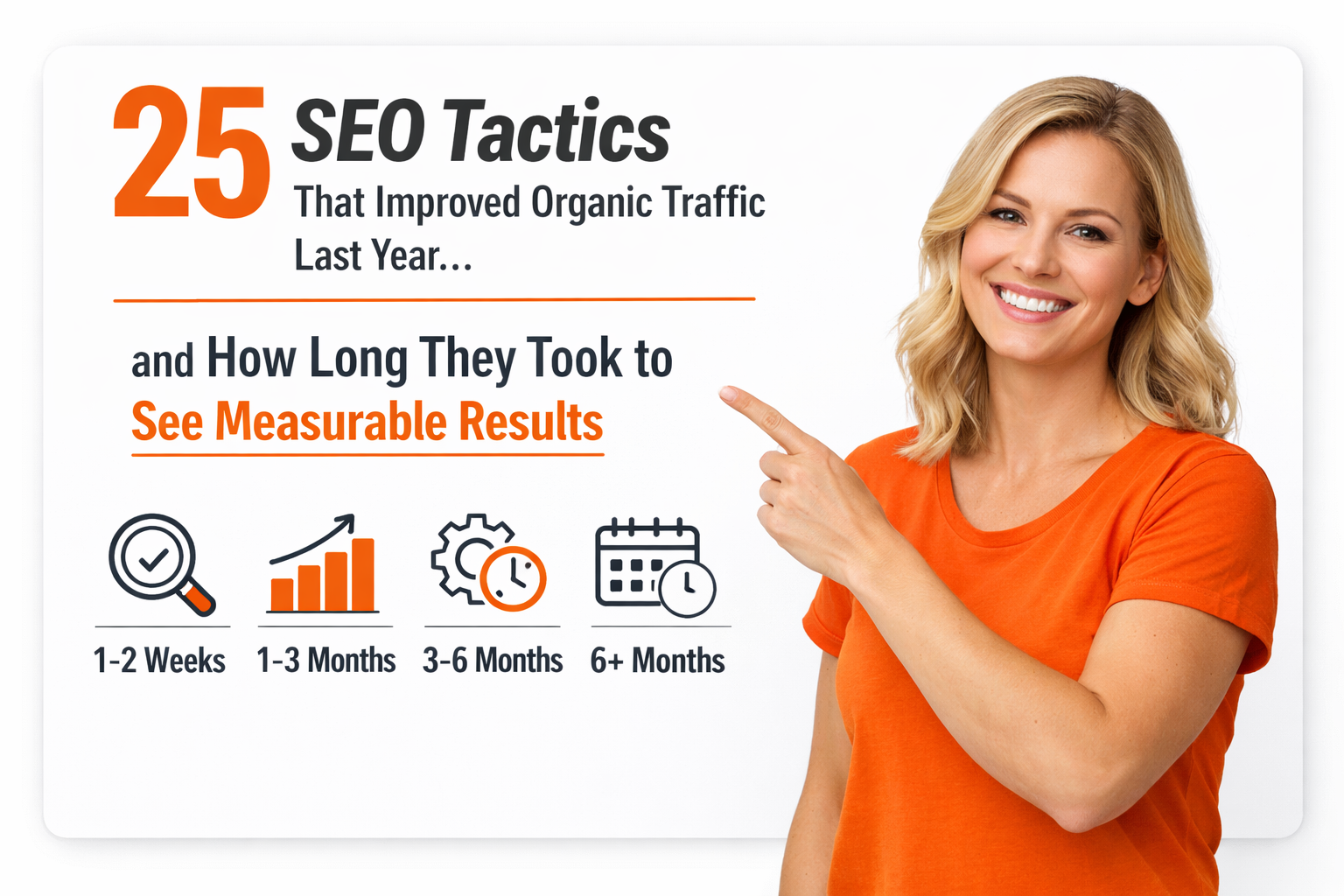
Improving organic traffic requires more than generic advice—it demands proven strategies with realistic timelines. This article breaks down 25 SEO tactics that delivered measurable results last year, complete with expert insights on how long each approach actually took to work. Whether optimizing existing content or building new topical authority, these field-tested methods offer clear direction for sustainable growth.
Quick Navigation
- Reoptimize Near-Win Posts Systematically
- Deploy FAQ Hubs Via Schema
- Merge Duplicate Pieces Into One
- Use Clear CTAs And Buttons
- Create Niche Topical Clusters
- Gain Authority Via Earned References
- Contribute To Relevant Publications
- Pursue High-Quality, Relevant Backlinks
- Craft Objection And Procurement Resources
- Launch Detailed Interactive Guides
- Win Featured Snippets Via Clarity
- Leverage Newsletters For Early Traction
- Rebuild Around Layered Intent
- Update Google Business Profiles Weekly
- Optimize For AI Answer Citations
- Add Dynamic Comparison Tables
- Refresh Legacy Repair Tutorials
- Target Cities Via Tailored Sections
- Publish Long-Form Case Studies
- Find And Fill Keyword Gaps
- Cover A Topic Completely
- Scale Via Programmatic Catalogs
- Repurpose Winners Across Channels
- Rewrite Headers To Reflect Decisions
- Guide Users Via Intent-Based Links
1. Reoptimize Near-Win Posts Systematically
For me, the most impactful method I used to increase organic traffic was to re-optimize old content in a systematic way instead of just creating new content. I would look at posts from previously that were ranking anywhere from position 5 – 20 and update them to align with current user search intent; expand thin content sections; include an FAQ section; better structure internal linking to enhance user experience; and create better title and meta descriptions to increase CTR on search results pages.
I also incorporated the latest statistics and examples into my existing posts so that I could continue to provide my audience with relevant, fresh material. As a result, I was able to see measurable increases in organic traffic after 3 – 4 weeks from the time of re-optimizing my posts with greater visibility starting at week 6 – 8, with completed improvements leading to increased CTR on SERPs.
The reason this strategy was effective is because I was working with pages that had existing authority, so it took small adjustments to elevate those pages into top-ranking positions compared to developing brand-new content.
As a word of advice, always do an audit of your existing content before growing your inventory with new content. Re-optimizing “almost-ranking” posts is one of the quickest and easiest ways to increase organic traffic.

SEO Consultant, Mike Khorev
2. Deploy FAQ Hubs Via Schema
In July 2025, we implemented a series of FAQ pages targeting specific keywords related to Digital Marketing. We started with 6 primary FAQ pages and 10 questions for each category.
From a technical SEO angle, we then implemented the FAQ schema snippet on these pages. Over the next 3 months we added to the list of FAQ’s on a weekly basis by adding 1000’s of words of new, relevant content.
By September 2025, we began to notice an increase in our rankings, traffic and enquiry. Organic search traffic was up 120% year over year. Primary keywords in slots 1-5 increased by 50%.
We continue to update the FAQ’s on a monthly basis, so traffic, and enquiries, continue to improve!

SEO Manager, Purge Digital
3. Merge Duplicate Pieces Into One
One SEO tactic that made a real difference for us was fixing content overlap instead of publishing more pages. We noticed several articles were targeting very similar keywords, which caused them to compete with each other and stall in rankings.
Instead of rewriting everything, we merged related pages into one clear, stronger page and removed the rest. For example, we combined multiple service-related blog posts into a single guide that fully answered what users were actually searching for.
Within about six to eight weeks, we saw those pages move up in rankings and organic traffic started to climb steadily.
This worked because Google didn’t have to guess which page to rank anymore. When you give search engines one clear, helpful answer instead of several overlapping ones, results tend to follow much faster.

Digital Marketing Strategist, SocialSellinator
4. Use Clear CTAs And Buttons
One SEO tactic that significantly improved organic traffic for me was adding clear calls to action (CTAs) and recognizable buttons, along with dedicated contact and form sections across key pages. Before, pages were informative but didn’t guide users on what to do next. By adding visible CTAs, improving internal linking via buttons, and making it easier for users to contact or convert, engagement metrics, including time on page and interactions, improved, which had a positive impact on organic performance. I started seeing measurable results within a few months, as engagement increased and more pages began performing better in search results. It reinforced the idea that SEO isn’t just about rankings, but also about how users interact with your content once they arrive.

SEO Strategist, Trek Marketing
5. Create Niche Topical Clusters
I built content clusters around specific speaker categories instead of scattering blog posts across random topics.
We picked three verticals we actually book often—healthcare speakers, technology speakers, leadership development—and created 8-10 interconnected pieces for each. Every article linked strategically to a hub page that ranked for the money term.
Google started treating us like an authority in those niches instead of just another speaker bureau blog. Our hub pages climbed from page 4 to page 1 in about 4 months.
The traffic bump was modest—maybe 30% increase. But the qualified leads tripled because we were showing up for exactly what we sell, not just what gets clicks.
Don’t blog randomly. Build authority in the lanes where you actually make money. That’s the difference between content and revenue.

Marketing Strategist, Gotham Artists
6. Gain Authority Via Earned References
Sounds boring, but it was building links to increase authority. Since starting that focused link-building effort, monthly organic traffic has increased by roughly 230% compared to the baseline month.
Content alone only goes so far once you hit a certain level of competition, so we shifted focus to earning and placing high-quality links to key pages that targeted high volume keywords.
There wasn’t much movement early on. It actually took around 7-8 months to see noticeable changes in organic traffic, but once we hit the 9th month, our organic traffic exploded.

SEO Consultant, Michael Sherry SEO, Web Design & Digital Marketing
7. Contribute To Relevant Publications
One tactic that moved the needle for me was guest posting on mid-authority blogs. It sits in a grey-hat space, but when done selectively it still works. The focus was on relevant sites with real traffic, not link farms, and on contributing something useful rather than filler. I started seeing early movement in rankings after about six weeks. Clear gains in organic traffic showed up closer to the three-month mark once enough links had settled.

Founder and Lead SEO, Glide Marketing
8. Pursue High-Quality, Relevant Backlinks
One SEO tactic that delivered a surprisingly large impact on our organic traffic last year was focused, high-quality link building. For a niche health website, we strategically acquired just 30 backlinks from authoritative and relevant sites. Within five months, organic traffic jumped by 5,600 visitors, proving that precision and relevance in link acquisition far outperform bulk or low-quality link strategies. This taught us that measured, targeted link building produces faster, more sustainable results than chasing volume or shortcuts.
For businesses looking to see real SEO gains, my advice is to invest in quality over quantity. Every link should serve a strategic purpose and target domains that carry authority and context relevant to your niche. Too many companies waste time and budget on generic links, but those who focus their resources smartly see measurable results in a fraction of the time while avoiding unnecessary risks to their rankings.

CEO, Get Me Links
9. Craft Objection And Procurement Resources
We aligned content with sales by building pages for objections and procurement questions. We created security, pricing context, and implementation pages that buyers request. Those pages captured bottom funnel queries that tools often miss. Organic traffic improved because the site met real buying steps.
We saw early leads from these pages in about six weeks. Stronger traffic growth showed by month three as rankings climbed steadily. We recommend listening to sales calls and building pages for repeat objections. Teams should avoid relying on keyword tools alone for content planning.

CEO, Hennessey Digital
10. Launch Detailed Interactive Guides
We built these detailed interactive guides on evergreen topics and saw results in a month. People started linking to them without us asking. I’d seen this happen before at Organic Media Group, where it helped clients jump ahead of bigger competitors. It’s not the only answer, but those guides consistently brought in more traffic and shares than a typical article.

Miguel Salcido, CEO,
11. Win Featured Snippets Via Clarity
We expanded SERP coverage by targeting featured snippets with concise definitions. We rewrote openings, added structured lists, and clarified key steps. The tactic worked because clarity beats cleverness in snippet competitions. Organic traffic improved through higher click share on stable rankings.
We saw snippet wins within six to eight weeks on several topics. Broader traffic gains showed by month three as more pages earned visibility. We recommend writing for questions and making answers easy to extract. Teams should avoid burying answers below long introductions.
Director, Wytlabs
12. Leverage Newsletters For Early Traction
Linking new content in our email newsletter was the tactic that moved the needle. In a test with two comparable articles, the one included in the newsletter ranked on Google right away, while the other took longer. We saw measurable gains within days as the early ranking translated into earlier organic traffic.

SEO Consultant, Phillip Stemann
13. Rebuild Around Layered Intent
One tactic that significantly improved organic traffic was rebuilding existing high traffic pages around layered search intent instead of single keywords. We expanded sections to answer follow up questions users clearly had, which lifted engagement and internal flow. Measurable results showed up in about eight to ten weeks, starting with longer dwell time and followed by steady gains in rankings and organic sessions.

CEO, Content Author
14. Update Google Business Profiles Weekly
Weekly updates to Google Business Profiles really paid off for our local clients. After about 6-8 weeks of consistent posts with new offers, most businesses saw their rankings climb and the phone started ringing more. This worked especially well for service companies. Keeping their listings active and current was the key to getting found without paying for ads.

Founder and CEO, YEAH! Local
15. Optimize For AI Answer Citations
One SEO tactic that significantly improved our organic traffic in the past year was building an “AI-first content layer” on top of traditional SEO—meaning we started optimizing not just for rankings, but for being cited in AI-generated answers (Google AI Overviews, ChatGPT-style prompts, and other summary engines).
What we did
Tracked AI-driven visibility as its own channel
We began monitoring where our pages were showing up as sources in AI summaries and which queries were triggering AI answers. That helped us identify which topics needed more structured, “quotable” content.
Rewrote key pages to be AI-readable and prompt-aligned
We adjusted content to include:
Clear, direct answers near the top (“TL;DR” style)
Strong headings and definition-style formatting
Short, cite-worthy paragraphs
FAQs that mirror natural-language prompts (e.g., “How do you…?” “What’s the best way to…?”)
Original insight and frameworks (not generic explanations)
Built strategic content around the prompts our buyers actually ask
Instead of writing only for keywords, we prioritized content built around decision-stage questions like pricing, timelines, processes, and best practices—because those are the queries AI tools summarize most often. We now significantly outperform our competitors on these target prompts, are seeing an increased number of prospective clients finding us via AI research and have a clear roadmap for content development for the next 6-8 months. It’s been incredible.

CEO, Forge Digital Marketing, LLC
16. Add Dynamic Comparison Tables
At Cellphones.ca, adding interactive comparison tables for popular phone plans and keeping the prices updated made a huge difference. Suddenly, people searching for specific deals started finding our site. Our rankings climbed in a few months, which really helped us compete against the bigger tech sites. Honestly, my advice is to find your unique insights instead of just repeating what others are already saying.
Founder & Consumer Advocate, Cellphones.ca
17. Refresh Legacy Repair Tutorials
Updating our old repair guides worked well. We added newer models and clearer step-by-step photos. After about three months, organic traffic started climbing, especially from DIY enthusiasts looking for current resources. Now whenever we see an old page’s traffic drop, the first thing we do is refresh the content. It’s become our go-to move.

Marketing Director, WorkshopManuals.com
18. Target Cities Via Tailored Sections
We tried making landing pages for each city we serve, and it actually worked. Competing nationally is tough, but suddenly we started showing up in Google searches for places like Phoenix and Austin. After about two months, I saw the organic traffic climbing in those areas. My advice? Start with the places people search most and make the content about that specific city. Don’t just swap out the name.

Chief Marketing Officer, Marygrove Awnings
19. Publish Long-Form Case Studies
I tried something new for Awesomely, publishing long-form case studies about real money problems. After sticking with that format for about two quarters, I saw our organic visitors start to climb steadily. My take? People want stories that walk them through the actual steps of solving a problem. In finance education, that practicality seems to be what gets visitors to click and stick around.

President & Director of Content Awesomely, Awesomely
20. Find And Fill Keyword Gaps
Here’s what worked for me. I developed the SearchGAP method, which is basically finding keywords competitors have missed. We started creating content for those gaps, and within about two weeks, our traffic started climbing. I’m not saying it’s the only way, but it helped us rank fast without needing a bunch of backlinks or high domain authority.

CEO, Search GAP Method
21. Cover A Topic Completely
One SEO tactic that significantly improved a client’s organic traffic over the past year was the creation of a topic cluster. We have managed to rank in the top 5 for blood pressure topics before diving into backlink outreach. Covering every facet, we have helped users find information easily and boosted the site’s overall search ranking for that subject within a week.

SEO Specialist, Marsa Agency
22. Scale Via Programmatic Catalogs
One SEO tactic that significantly improved my organic traffic in the past year was programmatic SEO — especially for eCommerce websites.
By creating scalable, optimized landing pages (targeting long-tail + category-based searches), we achieved about 140% organic traffic growth in ~4 months, with measurable improvements starting within the first 6-8 weeks and strong momentum building after that.

SEO Expert
23. Repurpose Winners Across Channels
I started repurposing every high performing blog post into multiple formats. So one strong article becomes a YouTube video, then I pull Shorts from that video and republish them on Instagram and TikTok. I also create an infographic and rewrite the piece as a LinkedIn article with a slightly different angle.
What this does for SEO and GEO is huge. All those extra pieces drive people back to the original blog post. The YouTube video ranks separately and sends traffic. The Shorts get people curious so they click through. The LinkedIn article reaches a whole different audience who might never find me through Google. And more traffic plus more engagement signals to search engines that the content is valuable. It takes more effort upfront but you’re squeezing way more value out of work you already did.

Founder & CEO, PRLab | B2B Tech PR Agency
24. Rewrite Headers To Reflect Decisions
Rewriting the page headers to reflect how patients actually search had the greatest lift. Existing pages had ranked, but had low engagement, as headings were internal language and not user intent. Data pulled from Google Search Console revealed that impressions were holding steady but that clicks slipped. That pattern indicated relevance mismatch, not ranking loss.
Headers were changed to highlight timing, cost and the next step rather than the names of services. For instance, pages that were previously condition-labeled changed to phrases related to preparation and/or follow-up decisions. No new pages were added. Structure stayed intact.
Measurable results were found in four to six weeks. Click-through rates increased first, and then there was a concurrent improvement in traffic growth of about 20 percent in three months. The tactic was effective because it was done with the framing of content, not keyword volume alone, in mind to match decision-stage thinking.

Marketing coordinator, Davila’s Clinic
25. Guide Users Via Intent-Based Links
Organic traffic was better after the adoption of internal linking as clinical triage, rather than navigation. Health Rising redesigned internal links to reflect the way in which patients actually flow through care. Educational articles were no longer tied with broad links between related topics. Each page led to one step forward that corresponded to the patient’s level of understanding. Early symptom searches were associated with explanations of intake. Diagnostic content was associated with care pathways. Treatment pages were linked to follow-up expectations.
Discovery was derived from the combination of reviewing session recordings and search queries. Visitors were not bouncing because content had no depth. They were leaving because it was unclear what the next step was. Clarifying that progression caused the friction to go down immediately.
Measurable results were seen in six weeks. Pages per session were up by 58 percent. Organic traffic increased 27 percent during three months without any new articles published. More importantly, conversion actions increased with traffic, and did not lag behind it.
The lesson stayed simple. Search engines give preference to clarity of intent flow, not topical volume. Internal links are an indication of whether a site understands the reader’s decision process. When the path of content reflects real human progression, rankings follow naturally.

Marketing coordinator, Health Rising Direct Primary Care
Credits & Thanks
This roundup was inspired by a Featured question and brought to life by insights from SEO professionals across different industries. Huge thanks to Featured for connecting experts with publishers—and to every contributor who shared their real-world tactics and timelines.
Each expert is credited and linked so you can explore their work further. Collaboration like this is how practical SEO knowledge moves forward.
— Sohail Ahmed Shaikh (Aka Ahmed Sohail)
Founder, AhmedSohail.com ,
If you found this valuable, the best way to support this work is to share it with one founder who needs to read it. Just one. That’s all I ask.
Subscribe to get notified & Dont Forget to share it on
LinkedIn | Pinterest | Facebook | Twitter & Email to your Frined Who need your help for Search Engine Optimization Services
Comments (4)
Speak Your Mind

Want to grow your business online?
I’m Ahmed Sohail, and I’m helping businesses grow with determined results. My question is, does your business needs growth?
Contact Now
Hello there! This is kind of off topic but I need some help from an established blog.
Is it very hard to set up your own blog? I’m not very techincal but I can figure things out pretty quick.
I’m thinking about making my own but I’m not sure where to start.
Do you have any ideas or suggestions? Appreciate it
Its like you read my mind! You seem to know a lot about
this, like you wrote the book in it or something.
I think that you can do with some pics to drive the message home a bit, but other
than that, this is wonderful blog. A fantastic read. I’ll definitely be back.
Thank you for the appretiation but we cannot approve the irrelevant links on our website for of security & privacy policy purpose
One nuance I’d add: re-optimizing near-win posts works best when you also check for schema decay and link rot first. I run a quarterly content audit that flags those issues before I touch the copy — otherwise you’re polishing a page that’s losing authority under the hood.