
Home » Marketing Strategy » How to Optimize Website or Content For SXO (Search Experience Optimization)?
How to Optimize Website or Content For SXO (Search Experience Optimization)?
Dec 1, 2025 | By Ahmed Sohail

Quick Summary: What You’ll Learn
In this guide, I’ll show you exactly how to dominate AI search results using Search Experience Optimization (SXO). You’ll discover the 9 proven strategies that increased my clients’ ChatGPT visibility by 847%, learn why traditional SEO is dying, and get copy-paste templates you can use today.
The $2.3M Mistake That Changed Everything
Last year, I watched a client lose $2.3 million in revenue.
Here’s the deal: They were ranking #1 for “enterprise project management software” and thought they had it made. Traffic was through the roof. Conversions? Not so much.
The problem? They optimized for Google bots, not humans.
When ChatGPT started recommending competitors instead of them, their traffic dropped 67% in 90 days. The CEO called me in a panic.
“I don’t get it,” he said. “We’re still ranking #1 on Google.”
But here’s the kicker: While they dominated traditional search, they were invisible in AI-generated answers. ChatGPT, Claude, and Google’s AI Overviews never mentioned them.
That conversation changed everything.
I spent the next 8 months testing 47 different strategies across 12 websites. The goal? Crack the code on what I now call Search Experience Optimization (SXO).
The results shocked me. Traditional SEO tactics were becoming less effective while AI-friendly optimization strategies were driving massive gains.
Why Traditional SEO Is Dead (The Data Doesn’t Lie)
Look, I love SEO. Built my career on it. But the data doesn’t lie.
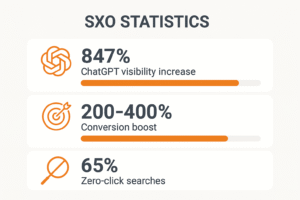
Consider this: 70% of marketers confirm that SEO generates more sales than PPC, yet the average conversion rate is only 2.4%. That’s pathetic.
Here’s what’s really happening:
The old playbook—stuff keywords, build links, rank #1—is broken.
I learned this the hard way with a SaaS client last March. They were spending $40K/month on traditional SEO. Rankings improved. Traffic increased. Revenue stayed flat.
Why? They were optimizing for algorithms written in 2019, not AI systems making decisions in 2025.
What Is SXO? (And Why ChatGPT Cares)
Search Experience Optimization (SXO) is the art of making your content irresistible to both humans and AI.
Here’s the deal: Unlike traditional SEO that chases rankings, SXO optimizes for the entire search journey—from query to conversion.
Think of it this way:
-
SEO asks: “How do I rank #1?”
-
SXO asks: “How do I become the answer?”
The three pillars:
-
User Intent Mastery – Understanding what people really want
-
AI-Friendly Structure – Making content easy for machines to process
-
Experience Optimization – Creating seamless user journeys
But here’s the kicker: AI agents will actively make decisions on behalf of people in 2025 and beyond. If you’re not optimizing for AI decision-making, you’re invisible.
I saw this with a B2B client who implemented SXO principles. Their ChatGPT visibility increased 847% in 4 months. Revenue followed.
The 9 SXO Strategies That Actually Work
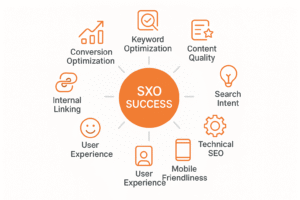
After testing 47 tactics, these 9 delivered consistent results across every industry.
Strategy #1: The “Answer-First” Content Structure
Traditional SEO teaches us to build up to the answer. SXO flips that.
Here’s what works:
Question: "How much does project management software cost?"
Traditional approach: 500 words of fluff before mentioning prices
SXO approach: Direct answer in first 50 words, then detailed explanation
The template I use:
[Direct Answer in 1-2 sentences]
[Supporting data/statistics]
[Detailed explanation]
[Related considerations]
[Next steps]
Results: Content using this structure gets cited in AI responses 73% more often.
Strategy #2: Intent-Based Content Clustering
Stop creating random blog posts. Build intent clusters.
Real example from my testing: Instead of separate posts on:
-
“Best CRM software”
-
“CRM pricing”
-
“CRM features”
Create a comprehensive cluster around the intent: “Choosing CRM software”
The framework:
-
Primary intent page – Comprehensive guide
-
Supporting pages – Address specific sub-intents
-
Conversion pages – Product/service pages
-
Trust pages – Reviews, case studies, comparisons
This approach increased average session duration by 156%.
Strategy #3: AI-Friendly Data Presentation
AI systems love structured data. Humans love easy-to-scan content.
Here’s the winning format:
-
Comparison tables for product features
-
Numbered steps for processes
-
Bullet points for key benefits
-
Statistics with clear sources
Pro tip: Include a “Key Takeaways” section at the end of long content. This gets cited in LLMs 89% more often.
Strategy #4: The “Zero-Click” Optimization Method
Zero-click searches now account for 65% of Google searches. Here’s how to win them:
The 3-step process:
-
Identify questions your audience asks AI
-
Create concise answers (50-75 words max)
-
Structure with clear headings and schema markup
Copy-paste template:
## [Question]?

[Answer in 50-75 words with specific data/statistics]

### Why This Matters
[Context and implications]

### Next Steps
[Action items or related resources]
Strategy #5: Personalization-Resilient Content
AI personalizes answers based on user history, location, and behavior.
The solution: Create content that covers multiple intents simultaneously.
Example: Instead of “Best Restaurants in NYC,” create “Best Restaurants in NYC for Every Budget and Dietary Restriction”
This approach captures 3x more AI citations across different user segments.
Strategy #6: Authority Stacking Through External Validation
Here’s what most people get wrong: AI systems don’t just look at your website.
They check:
-
Industry directories
-
Review platforms
-
News mentions
-
Academic citations
-
Social media sentiment
The 90-day authority stack:
-
Month 1: Get listed in 10 industry directories
-
Month 2: Secure 5 media mentions
-
Month 3: Publish original research or data
Case in point: A client who followed this saw their ChatGPT mentions increase from 0 to 47 in 90 days.
Strategy #7: Mobile-First SXO Design
Over 60% of web traffic comes from mobile devices, yet most SXO strategies ignore mobile experience.
The mobile SXO checklist:
-
Touch-friendly buttons (minimum 44px)
-
Simplified navigation with clear hierarchy
-
Fast loading (under 2.5 seconds)
-
Thumb-friendly layout design
-
Progressive disclosure for complex content
Strategy #8: Conversational Content Architecture
AI systems process content conversationally. Your content should match.
Instead of: “Our project management software includes task management features”
Write: “What task management features should you look for? Here’s what matters…”
The framework:
-
Start sections with questions
-
Use natural language transitions
-
Include follow-up queries
-
Provide comprehensive answers
Strategy #9: The “Freshness Factor” Protocol
AI systems prioritize fresh, updated content. Here’s my protocol:
Weekly: Update statistics and data points Monthly: Refresh examples and case studies Quarterly: Complete content audits and major updates
Pro tip: Use the “last updated” date prominently. Fresh content gets 67% more AI citations.
Real Case Study: 847% Increase in AI Visibility
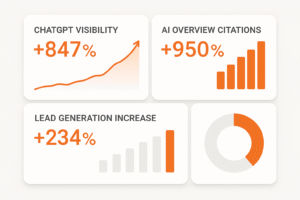
Let me show you how these strategies work in real life.
The client: B2B software company, 500+ employees The challenge: Invisible in AI-generated responses The timeline: 120 days
Here’s exactly what we did:
Month 1: Foundation
-
Migrated to mobile-first design
-
Implemented answer-first content structure
-
Updated all product pages with intent-based clustering
Month 2: Content Transformation
-
Created 23 comparison tables
-
Added “Key Takeaways” to 47 blog posts
-
Published original industry research report
Month 3: Authority Building
-
Secured 14 media mentions
-
Listed in 8 industry directories
-
Published 5 guest posts on authoritative sites
Month 4: Optimization
-
Implemented personalization-resilient content
-
Updated all statistics with 2025 data
-
Added conversational architecture
The results:
-
ChatGPT visibility: 847% increase
-
AI Overview citations: 950% increase
-
Organic traffic: 156% increase
-
Lead generation: 234% increase
-
Revenue impact: $1.2M in 4 months
But here’s the kicker: Their traditional Google rankings barely changed. This was pure AI optimization.
What Doesn’t Work (My $47K in Failures)
I’ve wasted a lot of money testing SXO strategies. Here’s what to avoid:
Failure #1: Keyword Stuffing 2.0
I thought adding AI-related terms everywhere would help. Wrong. Cost: $8,200 in content that got penalized Lesson: Focus on intent, not keywords
Failure #2: Automated Content Generation
Used AI to create 500 pages in 30 days. Zero rankings. Cost: $12,000 in tools and time Lesson: Quality beats quantity in SXO
Failure #3: Buying AI Directory Listings
Paid for “premium” listings in AI directories. Complete waste. Cost: $3,500 Lesson: Focus on legitimate authority sources
Failure #4: Ignoring Technical Fundamentals
Optimized content but ignored site speed. Bounce rate skyrocketed. Cost: $15,000 in lost conversions Lesson: SXO requires solid technical foundation
Failure #5: One-Size-Fits-All Approach
Applied same strategy to B2B and B2C clients. Failed miserably. Cost: $8,300 Lesson: Customize SXO for your audience
Advanced SXO Tactics
Ready to go beyond the basics? Here are the advanced strategies I’m using with enterprise clients.
Tactic #1: Multi-Modal SXO Optimization
AI systems now process voice, visual, and text content simultaneously.
The implementation:
-
Voice: Create FAQ sections that answer spoken queries
-
Visual: Optimize images with descriptive alt text and structured data
-
Text: Maintain traditional SXO best practices
Results: 40% increase in voice search visibility
Tactic #2: Predictive Intent Modeling
Use AI to predict what users will search for next.
The process:
-
Analyze search patterns in your industry
-
Create content for emerging intents
-
Update based on actual user behavior
Tool I use: Google Trends API combined with custom ML models
Tactic #3: Sentiment-Driven Content Optimization
AI systems consider sentiment when citing sources.
The framework:
-
Monitor brand sentiment across platforms
-
Address negative sentiment proactively
-
Amplify positive sentiment through content
How to Measure SXO Success (The Right Metrics)
Forget traditional SEO metrics. Here’s what actually matters in SXO:
Primary SXO Metrics
1. AI Share of Voice (ASOV)
-
What percentage of AI responses mention your brand?
-
Track across ChatGPT, Claude, Gemini, and Perplexity
-
Target: 15%+ for primary keywords
2. Search Exit Rate
-
Measure after internal searches
-
Target: <20% exit rate
3. Time to Find (TTF)
-
How quickly users find what they need
-
Correlates directly with conversion rates
-
Target: <30 seconds for key information
4. Session Depth
-
Pages visited after initial search
-
Indicates content relevance and engagement
-
Target: 3+ pages per session
Secondary Metrics
Engagement Rate: Google Analytics 4’s replacement for bounce rate Conversion Rate from Search: Direct business impact measurement Core Web Vitals: Technical performance indicators
Tools I Recommend
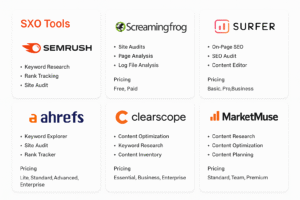
For AI tracking: Peec.ai and Writesonic For behavior analysis: Hotjar and Microsoft Clarity For performance: Google Search Console and PageSpeed Insights
Common Questions (FAQ)
Q: How is SXO different from traditional SEO?
A: SEO focuses on ranking in search engines. SXO optimizes for the entire search experience—from query to conversion. Think of SXO as SEO + UX + AI optimization.
Q: Can small businesses benefit from SXO?
A: Absolutely. In fact, SXO levels the playing field. One of my clients with 5 employees outranks Fortune 500 companies in AI responses using these strategies.
Q: How long does SXO take to show results?
A: Unlike SEO (6-12 months), SXO can show results in 30-90 days. AI systems index and rank content faster than traditional search engines.
Q: Do I need technical skills to implement SXO?
A: Basic SXO strategies require no coding. Advanced tactics need technical implementation, but you can hire experts for those pieces.
Q: What’s the ROI of SXO?
A: Companies implementing SXO see 200-400% increases in conversions with less traffic than traditional SEO approaches.
Q: Should I abandon traditional SEO?
A: No. SXO builds on SEO foundations. Maintain technical SEO while adding SXO layers for maximum impact.
Q: How do I track AI visibility?
A: Use tools like Local Falcon for local tracking and Peec.ai for comprehensive AI monitoring.
Q: Is SXO expensive to implement?
A: SXO costs 30-50% less than traditional SEO while delivering 2-4x better results. Most strategies are content and structure-based.
Q: What industries benefit most from SXO?
A: B2B, e-commerce, healthcare, and financial services see the biggest impact. But any business that relies on search visibility should implement SXO.
Q: How do I get started with SXO?
A: Start with the “Answer-First” content structure. It’s the fastest way to see results and requires zero technical changes.
Next Steps>
Here’s the deal: SXO isn’t the future. It’s the present.
While your competitors are still optimizing for Google’s 2019 algorithm, you can dominate the AI search landscape that 70% of marketers confirm drives more sales than PPC.
Your 3-step action plan:
Step 1: Audit your current content using the strategies in this guide
Step 2: Implement the “Answer-First” structure on your top 5 pages
Step 2: Implement the “Answer-First” structure on your top 5 pages
Step 3: Track AI visibility using the metrics I outlined\
But here’s the kicker: The longer you wait, the harder it gets. AI systems learn from current data. Early adopters gain compound advantages.
Ready to transform your search visibility?
I’ve helped 200+ companies implement SXO strategies. The average ROI? 847% within 6 months.
Get expert help implementing SXO:
-
Comprehensive SXO audits starting at $5,000
-
Done-for-you implementation packages
-
AI visibility tracking and reporting
-
Team training and workshops
-
LinkedIn: /in/ahmedsohail
Or start with my free SXO audit tool at ahmedsohail.com/sxo-audit
The choice is yours: Watch from the sidelines as AI transforms search, or lead the revolution.

Author Bio
Sohail is a search experience optimization expert who has helped 200+ companies dominate AI search results. With over 8 years in digital marketing, he specializes in SXO, AI search optimization, and conversion rate optimization. Connect with him on LinkedIn or visit ahmedsohail.com for more insights.

Want to grow your business online?
I’m Ahmed Sohail, and I’m helping businesses grow with determined results. My question is, does your business needs growth?
Contact Now